Band 676
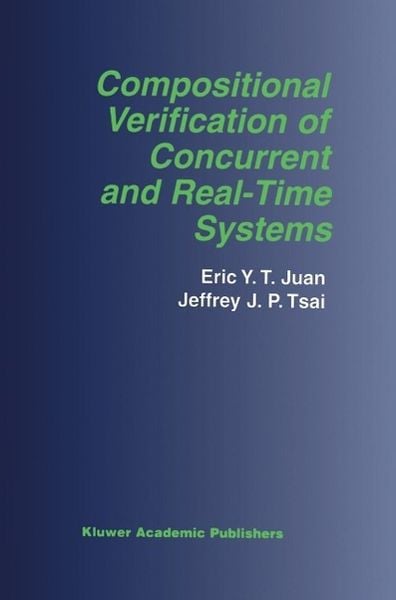
Compositional Verification of Concurrent and Real-Time Systems
-
- Hardcover
- Taschenbuch
- eBook ausgewählt
-
Form:Einzelkauf Download
-
Sprache:Englisch
Fr. 125.90
inkl. gesetzl. MwSt.Beschreibung
Produktdetails
Format
Kopierschutz
Nein
Family Sharing
Nein
Text-to-Speech
Nein
Erscheinungsdatum
06.12.2012
Verlag
Springer UsSeitenzahl
196 (Printausgabe)
Dateigröße
16114 KB
Sprache
Englisch
EAN
9781461510093
With the rapid growth of networking and high-computing power, the demand for large-scale and complex software systems has increased dramatically. Many of the software systems support or supplant human control of safety-critical systems such as flight control systems, space shuttle control systems, aircraft avionics control systems, robotics, patient monitoring systems, nuclear power plant control systems, and so on. Failure of safety-critical systems could result in great disasters and loss of human life. Therefore, software used for safety critical systems should preserve high assurance properties. In order to comply with high assurance properties, a safety-critical system often shares resources between multiple concurrently active computing agents and must meet rigid real-time constraints. However, concurrency and timing constraints make the development of a safety-critical system much more error prone and arduous. The correctness of software systems nowadays depends mainly on the work of testing and debugging. Testing and debugging involve the process of de tecting, locating, analyzing, isolating, and correcting suspected faults using the runtime information of a system. However, testing and debugging are not sufficient to prove the correctness of a safety-critical system. In contrast, static analysis is supported by formalisms to specify the system precisely. Formal verification methods are then applied to prove the logical correctness of the system with respect to the specification. Formal verifica tion gives us greater confidence that safety-critical systems meet the desired assurance properties in order to avoid disastrous consequences.
Noch keine Bewertungen vorhanden
Verfassen Sie die erste Bewertung zu diesem Artikel
Helfen Sie anderen Kundinnen und Kunden durch Ihre Meinung.