Gutscheinbedingungen

*Gültig bis 04.08.2026 auf (fast) alles. Ausgeschlossen sind Smartboxen, Zeitschriften, Tickets, Lebensmittel, Gaming-Elektroartikel, Tinte/Toner, Gutscheine, Geschenkkarten, Blumen und Abos | Einlösbar in allen Buchhandlungen von Orell Füssli, Barth Bücher, Buchladen Rapunzel, Papeterie Köhler, Schuler Orell Füssli, Stauffacher und ZAP unter Vorweisung des Gutscheins, auf www.orellfüssli.ch durch Eingabe des Gutscheincodes. Beim Service „eBooks verschenken“ und bei eBook-Käufen via eReader nicht einlösbar | Mindesteinkaufswert: Fr. 30.- | Nicht mit anderen Rabatten kumulierbar.

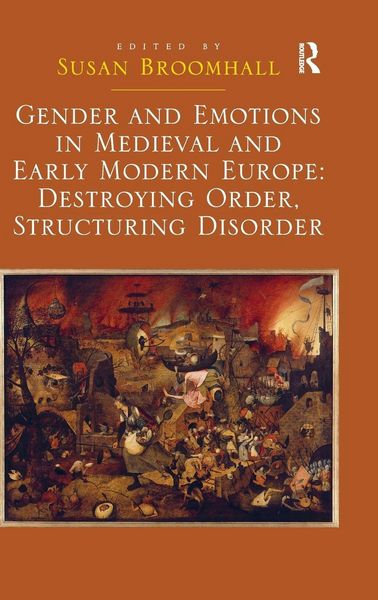
  • Produktbild: Gender and Emotions in Medieval and Early Modern Europe
  • Produktbild: Gender and Emotions in Medieval and Early Modern Europe

Gender and Emotions in Medieval and Early Modern Europe Destroying Order, Structuring Disorder

Fr. 253.00

inkl. gesetzl. MwSt., Versandkostenfrei


Beschreibung

Produktdetails

Einband

Gebundene Ausgabe

Erscheinungsdatum

10.11.2015

Verlag

Taylor and Francis

Seitenzahl

282

Maße (L/B/H)

24/16.1/2 cm

Gewicht

680 g

Sprache

Englisch

ISBN

978-1-4724-5327-3

Beschreibung

Produktdetails

Einband

Gebundene Ausgabe

Erscheinungsdatum

10.11.2015

Verlag

Taylor and Francis

Seitenzahl

282

Maße (L/B/H)

24/16.1/2 cm

Gewicht

680 g

Sprache

Englisch

ISBN

978-1-4724-5327-3

Herstelleradresse

Libri GmbH
Europaallee 1
36244 Bad Hersfeld
DE

Email: gpsr@libri.de

Noch keine Bewertungen vorhanden

Verfassen Sie die erste Bewertung zu diesem Artikel

Helfen Sie anderen Kundinnen und Kunden durch Ihre Meinung.

Kundinnen und Kunden meinen

Bewertungen (0)

Die Leseprobe wird geladen.
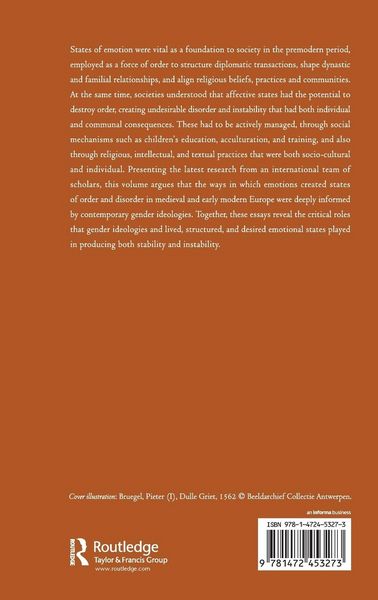
  • Produktbild: Gender and Emotions in Medieval and Early Modern Europe
  • Produktbild: Gender and Emotions in Medieval and Early Modern Europe
  • Introduction: destroying order, structuring disorder: gender and emotions, Susan Broomhall. Part I Structuring Emotions of War and Peace: ‘Now evil deeds arise’: evaluating courage and fear in early English fight narratives, Andrew Lynch; Order, emotion, and gender in the crusade letters of Jacques de Vitry, Megan Cassidy-Welch; Married noblewomen as diplomats: affective diplomacy, Tracy Adams; Ordering distant affections: fostering love and loyalty in the correspondence of Catherine de Medici to the Spanish court, 1568-1572, Susan Broomhall. Part II Chronicling Feelings of Disaster and Ruin: Emotions and the social order of time: constructing history at Louvain’s Carthusian House, 1486-1525, Matthew S. Champion; A landscape of ruins: decay and emotion in late medieval and early modern antiquarian narratives, Alicia Marchant; ‘O, Lord, save us from shame’: narratives of emotions in convent chronicles by female authors during the Dutch revolt, 1566-1635, Erika Kuijpers; Recasting images of witchcraft in the later 17th century: the witch of Endor as ritual magician, Charles Zika. Part III Aligning Children, Familial, and Religious Communities: ‘That the boys come to school half an hour before the girls’: order, gender, and emotion in school, 1300-1600, Annemarieke Willemsen; An ordered cloister? Dissenting passions in early modern English cloisters, Claire Walker; ‘Will we ever meet again?’ Children travelling the world in the late 17th and 18th centuries, Claudia Jarzebowski; Gendered power and emotions: the religious revival movement in Herrnhut in 1727, Jacqueline Van Gent. Select bibliography; Index.