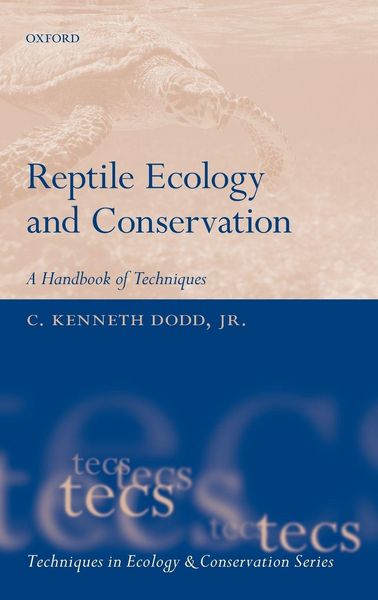
Reptile Ecology and Conservation
Aus der Reihe
Techniques in Ecology & Conservation
-
- Hardcover ausgewählt
- Taschenbuch
- eBook
-
Sprache:Englisch
Fr. 218.00
inkl. gesetzl. MwSt.,
Beschreibung
Produktdetails
Einband
Gebundene Ausgabe
Erscheinungsdatum
19.02.2015
Herausgeber
C. Kenneth, Jr. DoddVerlag
Oxford University PressSeitenzahl
496
Maße (L/B/H)
24/16.1/3.1 cm
Gewicht
904 g
Sprache
Englisch
ISBN
978-0-19-872613-5
This practical handbook of reptile field ecology and conservation brings together a distinguished, international group of reptile researchers to provide a state-of-the-art review of the many new and exciting techniques used to study reptiles. The authors describe ecological sampling techniques and how they are implemented to monitor the conservation status and population trends of snakes, lizards, tuatara, turtles, and crocodilians throughout the world. Emphasis is placed on the extent of statistical inference and the biases associated with different techniques and analyses.
The chapters focus on the application of field research and data analysis for achieving an understanding of reptile life history, population dynamics, movement patterns, thermal ecology, conservation status, and the relationship between reptiles and their environment. The book emphasises the need for thorough planning, and demonstrates how a multi-dimensional approach incorporates information related to morphology, genetics, molecular biology, epidemiology, statistical modelling, animal welfare, and biosecurity. Although accentuating field sampling, sections on experimental applications in laboratories and zoos, thermal ecology, genetics, landscape ecology, disease and biosecurity, and management options are included. Much of this information is scattered in the scientific literature or not readily available, and the intention is to provide an affordable, comprehensive synthesis for use by graduate students, researchers, and practising conservationists worldwide.
The chapters focus on the application of field research and data analysis for achieving an understanding of reptile life history, population dynamics, movement patterns, thermal ecology, conservation status, and the relationship between reptiles and their environment. The book emphasises the need for thorough planning, and demonstrates how a multi-dimensional approach incorporates information related to morphology, genetics, molecular biology, epidemiology, statistical modelling, animal welfare, and biosecurity. Although accentuating field sampling, sections on experimental applications in laboratories and zoos, thermal ecology, genetics, landscape ecology, disease and biosecurity, and management options are included. Much of this information is scattered in the scientific literature or not readily available, and the intention is to provide an affordable, comprehensive synthesis for use by graduate students, researchers, and practising conservationists worldwide.
Noch keine Bewertungen vorhanden
Verfassen Sie die erste Bewertung zu diesem Artikel
Helfen Sie anderen Kundinnen und Kunden durch Ihre Meinung.