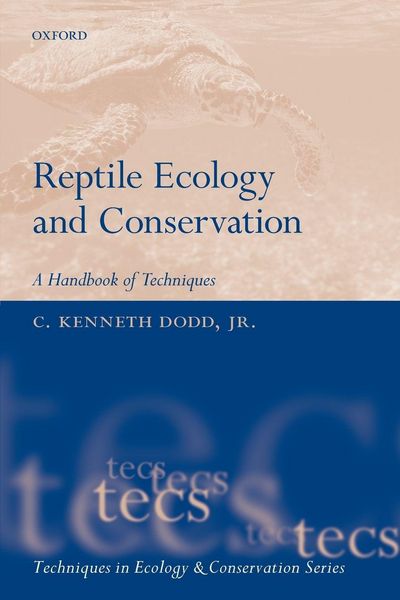
Produktbild: Reptile Ecology and Conservation

Reptile Ecology and Conservation A Handbook of Techniques

Fr. 113.00

inkl. gesetzl. MwSt., Versandkostenfrei


Beschreibung

Produktdetails

Einband

Taschenbuch

Erscheinungsdatum

05.07.2016

Herausgeber

C. Kenneth Dodd Jr.

Verlag

Oxford University Press

Seitenzahl

492

Maße (L/B/H)

23.4/15.6/2.6 cm

Gewicht

745 g

Sprache

Englisch

ISBN

978-0-19-872614-2

Beschreibung

Produktdetails

Einband

Taschenbuch

Erscheinungsdatum

05.07.2016

Herausgeber

C. Kenneth Dodd Jr.

Verlag

Oxford University Press

Seitenzahl

492

Maße (L/B/H)

23.4/15.6/2.6 cm

Gewicht

745 g

Sprache

Englisch

ISBN

978-0-19-872614-2

Kundinnen und Kunden meinen

0 Bewertungen

Informationen zu Bewertungen

Zur Abgabe einer Bewertung ist eine Anmeldung im Konto notwendig. Die Authentizität der Bewertungen wird von uns nicht überprüft. Wir behalten uns vor, Bewertungstexte, die unseren Richtlinien widersprechen, entsprechend zu kürzen oder zu löschen.

Die Bewertungen sind nach Format, Anzahl Sterne und Datum sortiert.

Verfassen Sie die erste Bewertung zu diesem Artikel

Helfen Sie anderen Kund*innen durch Ihre Meinung

Kundinnen und Kunden meinen

0 Bewertungen filtern

Die Leseprobe wird geladen.
  • Produktbild: Reptile Ecology and Conservation
    • Part 1. Introduction

    • 1: Laurie Vitt: Reptile diversity and life history

    • 2: Robert N. Fisher: Planning and setting objectives in field studies

    • 3: Richard Seigel: Data collection and storage

    • Part 2. The Individual

    • 4: John W. Ferner and Michael V. Plummer: Measuring and marking reptiles

    • 5: Roberto Sacchi, Stefano Scali, Marco Mangiacotti, Marco Sannolo, Marco Alberto Luca Zuffi: Digital identification and analysis

    • 6: Steve W. Gotte, Jeremy F. Jacobs, and George R. Zug: Preserving specimens for additional study

    • 7: Gunther Köhler: Reproduction

    • 8: Luca Luiselli and Giovanni Amori: Diet

    • 9: Bruce Kingsbury and Nathan J. Robinson: Movement patterns and telemetry

    • Part 3. Sampling Reptiles

    • 10: John D. Willson: Surface-dwelling reptiles: coverboards, drift fences and arrays

    • 11: Robert Henderson, Robert Powell, Jose Martín, and Pilar Lopez: Arboreal and fossorial reptiles

    • 12: Xavier Bonnet, Arne R. Rasmussen and François Brischoux: Sea snakes

    • 13: Richard Vogt: Freshwater turtles

    • 14: Margaretha Hofmeyr and Brian Henen: Terrestrial turtles and tortoises

    • 15: Seth Stapleton and Karen Eckert: Sea turtles

    • 16: Charlie Manolis and Matt Brien: Crocodilians

    • Part 4. Reptiles in the Community

    • 17: Tiffany M. Doan: Plot and transect censuses

    • 18: Indraneil Das: Rapid assessments of reptile diversity

    • 19: Henry Mushinsky and Earl McCoy: Measuring microhabitats used by non-avian reptiles

    • 20: Christine Bishop: Water quality and toxicology

    • 21: C. Kenneth Dodd, Jr.: Richness, diversity and similarity

    • 22: Monika Böhm and Viorel D. Popescu: Landscape ecology, biogeography and GIS methods

    • Part 5. Experimental Applications, Physiological Ecology, Genetics

    • 23: Stephen J. Mullin: Experimental applications

    • 24: Keith Christian, Richard Tracy, and Christopher Tracy: Body temperatures and the thermal environment

    • 25: Nancy Fitzsimmons and Joanne Sumner: Genetics in field ecology and conservation

    • Part 6. Trends Analysis and Conservation Options

    • 26: Darryl MacKenzie: Occupancy models

    • 27: Chris Sutherland and J. Andrew Royle: Estimating abundance

    • 28: Elliott R. Jacobson: Disease, parasites, and biosecurity protocols

    • 29: David A. Pike: Conservation management of reptiles

    • 30: Brian Gratwicke, Matthew Neff, Lindsay Renick Mayer, Sharon Ryan, and Jennifer Sevin: Education and outreach