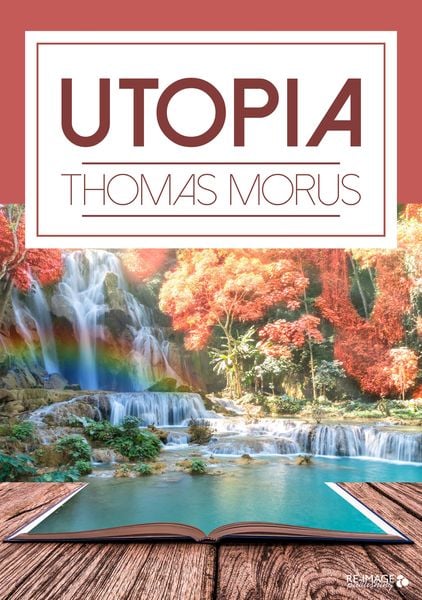
Utopia
1-
- Hardcover
- Taschenbuch
- eBook ausgewählt
- Hörbuch
-
Form:Einzelkauf Download
-
Sprache:Englisch
-
Verlag:Re-Image Publishing
- Zenith Crescent Moon Press Fr. 1.00
- Zenith Golden Quill Fr. 1.00
- Heritage Words Publishing Fr. 1.00
- Merkaba Press Fr. 1.00
- Zenith Ivory Tower Publications Fr. 1.00
- Zenith Horizon Publishing Fr. 1.00
- Zenith Whispering Pines Publishers Fr. 1.00
- Zenith Velvet Ink Publishing Fr. 1.00
- Echoes & Pages Press Fr. 1.00
- Candlelight Classics Fr. 1.00
- The Ebook Emporium Fr. 1.00
- Golden Quill Classics Fr. 1.00
- Zenith Evergreen Literary Co. Fr. 1.00
- Zenith Starlight Media Fr. 1.00
- Zenith Maple Leaf Press Fr. 1.00
- PergamonMedia Fr. 1.00
- Re-Image Publishing ausgewählt
- Booklassic Fr. 1.00
- Antique Editions Fr. 1.00
- Good Press Fr. 1.00
Fr. 1.00
inkl. gesetzl. MwSt.Beschreibung
Produktdetails
Format
ePUB
Kopierschutz
Nein
Family Sharing
Ja
Text-to-Speech
Ja
Erscheinungsdatum
29.06.2016
Verlag
Re-Image PublishingSeitenzahl
105 (Printausgabe)
Dateigröße
281 KB
Sprache
Englisch
EAN
9783958499232
De Optimo Republicae Statu deque Nova Insula Utopia (translated On the Best State of a Republic and on the New Island of Utopia) or more simply Utopia is a 1516 book by Sir (Saint) Thomas More.
The book, written in Latin, is a frame narrative primarily depicting a fictional island society and its religious, social and political customs. The name of the place is derived from the Greek words ¿¿ u and t¿p¿¿ tópos , with the topographical suffix -e¿a eía, hence ¿¿t¿pe¿a outopeía (Latinized as Utopia), "no-place land." It also contains a pun, however, because "Utopia" could also be the Latinization of ¿¿t¿pe¿a eutopeía, "good-place land," which uses the Greek prefix e¿ eu, "good," instead of ¿¿. One interpretation holds that this suggests that while Utopia might be some sort of perfected society, it is ultimately unreachable. Despite modern connotations of the word it is widely accepted that the society More describes in this work was not actually his own perfect society Rather he wished to use the contrast between the imaginary unusual political ideas and the chaotic politics of his own day as a platform from which to discuss social issues in Europe.
The book, written in Latin, is a frame narrative primarily depicting a fictional island society and its religious, social and political customs. The name of the place is derived from the Greek words ¿¿ u and t¿p¿¿ tópos , with the topographical suffix -e¿a eía, hence ¿¿t¿pe¿a outopeía (Latinized as Utopia), "no-place land." It also contains a pun, however, because "Utopia" could also be the Latinization of ¿¿t¿pe¿a eutopeía, "good-place land," which uses the Greek prefix e¿ eu, "good," instead of ¿¿. One interpretation holds that this suggests that while Utopia might be some sort of perfected society, it is ultimately unreachable. Despite modern connotations of the word it is widely accepted that the society More describes in this work was not actually his own perfect society Rather he wished to use the contrast between the imaginary unusual political ideas and the chaotic politics of his own day as a platform from which to discuss social issues in Europe.