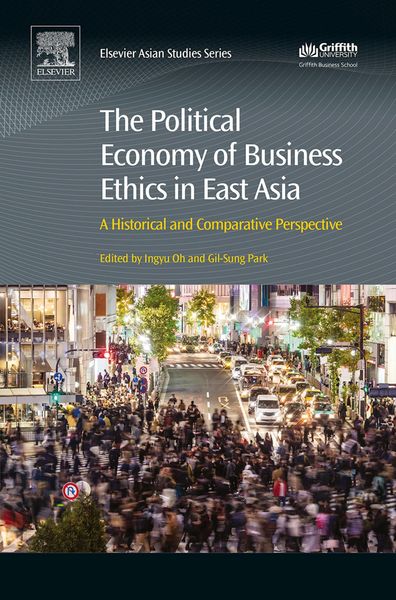
The Political Economy of Business Ethics in East Asia A Historical and Comparative Perspective
Aus der Reihe
Chandos Publishing
Fr. 121.90
inkl. gesetzl. MwSt.Beschreibung
Produktdetails
Format
ePUB 3
Kopierschutz
Nein
Family Sharing
Nein
Text-to-Speech
Ja
Erscheinungsdatum
28.09.2016
Herausgeber
Ingyu Oh + weitereVerlag
Elsevier Science & Techn.Seitenzahl
176 (Printausgabe)
Sprache
Englisch
EAN
9780081006955
The Political Economy of Business Ethics in East Asia: A Historical and Comparative Perspective deals with modes of ethical persuasion in both public and private sectors of the national economy in East Asia, from the periods of the fourteenth century, to the modern era. Authors in this volume ask how, and why, governments in pre-modern Joseon Korea, modern Korea, and modern Japan used moral persuasion of different kinds in designing national economic institutions.
Case studies demonstrate that the concept of modes of exchange first developed by John Lie (1992) provides a more convincing explanation on the evolution of pre-modern and modern economic institutions compared with Marx's modes of production as historically-specific social relations, or Smith's free market as a terminal stage of human economic development.
The pre-modern and modern cases presented in this volume reveal that different modes of exchange have coexisted throughout human history. Furthermore, business ethics or corporate social responsibility is not a purely European economic ideology because manorial, market, entrepreneurial, and mercantilist moral persuasions had widely been used by state rulers and policymakers in East Asia for their programs of advancing dissimilar modes of exchange. In a similar vein, the domination of the market and entrepreneurial modes in the twenty-first century world is also complemented by other competing modes of change, such as state welfarism, public sector economies, and protectionism.
- Compares Chinese, Japanese, and Korean business ethics from a comparative and historical context
- Explores recent theoretical approaches to capitalist development in modern history in non-Western regions
- Discusses the theoretical usefulness of new institutionalism, modes of exchange, and neoclassical discussions of business ethics
- Evaluates historical texts in their own languages in its attempt to compare Chinese, Japanese, and Korean business ethics in the pre-modern and modern times
Case studies demonstrate that the concept of modes of exchange first developed by John Lie (1992) provides a more convincing explanation on the evolution of pre-modern and modern economic institutions compared with Marx's modes of production as historically-specific social relations, or Smith's free market as a terminal stage of human economic development.
The pre-modern and modern cases presented in this volume reveal that different modes of exchange have coexisted throughout human history. Furthermore, business ethics or corporate social responsibility is not a purely European economic ideology because manorial, market, entrepreneurial, and mercantilist moral persuasions had widely been used by state rulers and policymakers in East Asia for their programs of advancing dissimilar modes of exchange. In a similar vein, the domination of the market and entrepreneurial modes in the twenty-first century world is also complemented by other competing modes of change, such as state welfarism, public sector economies, and protectionism.
- Compares Chinese, Japanese, and Korean business ethics from a comparative and historical context
- Explores recent theoretical approaches to capitalist development in modern history in non-Western regions
- Discusses the theoretical usefulness of new institutionalism, modes of exchange, and neoclassical discussions of business ethics
- Evaluates historical texts in their own languages in its attempt to compare Chinese, Japanese, and Korean business ethics in the pre-modern and modern times
Noch keine Bewertungen vorhanden
Verfassen Sie die erste Bewertung zu diesem Artikel
Helfen Sie anderen Kundinnen und Kunden durch Ihre Meinung.