Band 8
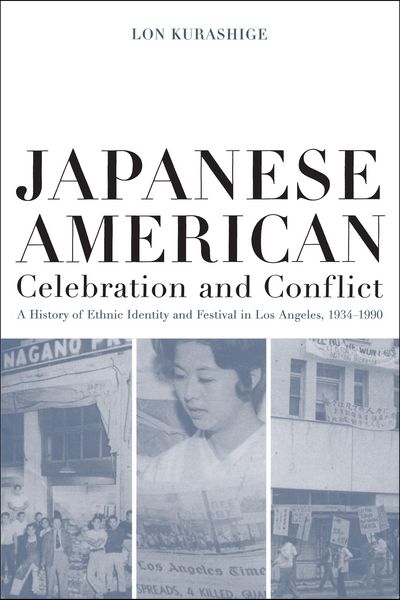
Japanese American Celebration and Conflict A History of Ethnic Identity and Festival, 1934-1990
Aus der Reihe
American Crossroads
-
- Taschenbuch
- eBook ausgewählt
-
Form:Einzelkauf Download
-
Sprache:Englisch
Fr. 35.90
inkl. gesetzl. MwSt.Beschreibung
Produktdetails
Format
Kopierschutz
Nein
Family Sharing
Nein
Text-to-Speech
Nein
Erscheinungsdatum
03.06.2002
Verlag
University of Virginia PressSeitenzahl
296 (Printausgabe)
Dateigröße
6865 KB
Auflage
1. Auflage
Sprache
Englisch
EAN
9780520926479
Do racial minorities in the United States assimilate to American values and institutions, or do they retain ethnic ties and cultures? In exploring the Japanese American experience, Lon Kurashige recasts this tangled debate by examining what assimilation and ethnic retention have meant to a particular community over a long period of time. This is an inner history, in which the group identity of one of America's most noteworthy racial minorities takes shape. From the 1930s, when Japanese immigrants controlled sizable ethnic enclaves, to the tragic wartime internment and postwar decades punctuated by dramatic class mobility, racial protest, and the influx of economic investment from Japan, the story is fraught with conflict.
The narrative centers on Nisei Week in Los Angeles, the largest annual Japanese celebration in the United States. The celebration is a critical site of political conflict, and the ways it has changed over the years reflect the ongoing competition over what it has meant to be Japanese American. Kurashige reveals, subtly and with attention to gender issues, the tensions that emerged at different moments, not only between those who emphasized Japanese ethnicity and those who stressed American orientation, but also between generations and classes in this complex community.
The narrative centers on Nisei Week in Los Angeles, the largest annual Japanese celebration in the United States. The celebration is a critical site of political conflict, and the ways it has changed over the years reflect the ongoing competition over what it has meant to be Japanese American. Kurashige reveals, subtly and with attention to gender issues, the tensions that emerged at different moments, not only between those who emphasized Japanese ethnicity and those who stressed American orientation, but also between generations and classes in this complex community.
Noch keine Bewertungen vorhanden
Verfassen Sie die erste Bewertung zu diesem Artikel
Helfen Sie anderen Kundinnen und Kunden durch Ihre Meinung.