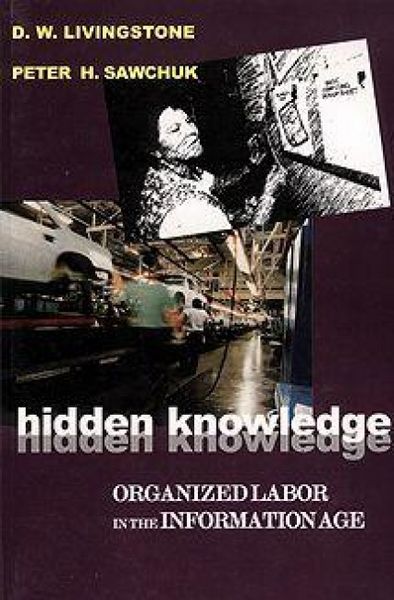

Hidden Knowledge Organized Labour in the Information Age
-
- Englisch ausgewählt
-
Verlag:University of Toronto Press
Fr. 71.90
inkl. gesetzl. MwSt.,
Beschreibung
Produktdetails
Einband
Taschenbuch
Erscheinungsdatum
01.10.2003
Verlag
University of Toronto PressSeitenzahl
320
Maße (L/B/H)
22.9/15.2/1.8 cm
Gewicht
440 g
Sprache
Englisch
ISBN
978-1-55193-045-9
Working people are more knowledgeable and actively engaged in learning than public discussion generally assumes. Two basic assumptions underlie much recent discussion about work and learning: a new "knowledge-based economy" is quickly emerging with new jobs generally requiring greater knowledge and skill; and, a "lifelong learning culture" must be created in order for workers to cope with these employment-related knowledge demands. Virtually every recent public policy statement about employment in every advanced industrial country begins with these assumptions. It implies that most workers suffer from a deficit of necessary skills and knowledge which must be rectified by greater education and training efforts. Hidden Knowledge challenges these assumptions. Through life history interviews and case study research with union members, the actual learning practices of working class people are documented in unprecedented detail.
Published Under the Garamond Imprint
Available in the US through Rowman & Littlefield.
Noch keine Bewertungen vorhanden
Verfassen Sie die erste Bewertung zu diesem Artikel
Helfen Sie anderen Kundinnen und Kunden durch Ihre Meinung.