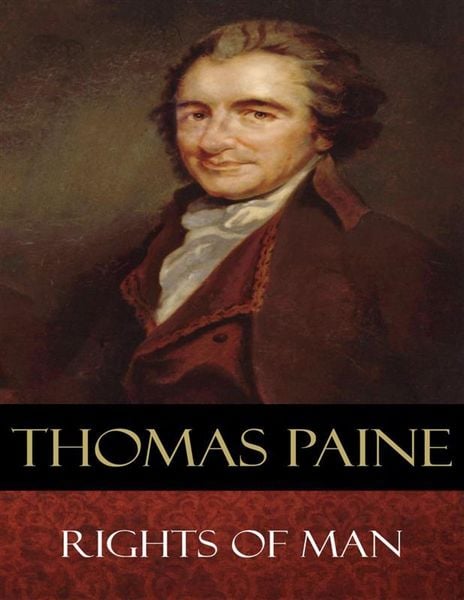
Rights of Man Annotated
-
- Hardcover
- Taschenbuch
- eBook ausgewählt
- Hörbuch
-
Form:Einzelkauf Download
-
Sprache:Englisch
-
eBook Format:ePUB
- PDF Fr. 4.90
- ePUB Fr. 1.90 ausgewählt
-
Verlag:BertaBooks
- Charles River Editors Fr. 2.00
- General Press Fr. 1.90
- Dreamscape Media Fr. 1.90
- BertaBooks Fr. 1.90 ausgewählt
- HarperCollins Canada Fr. 0.78
- True Sign Publishing House Fr. 1.90
- Start Publishing LLC Fr. 1.95
- Wilder Publications, Inc. Fr. 1.90
- Madison & Adams Press Fr. 2.00
- Copycat Fr. 2.40
- G&d Media Fr. 2.40
- Wilder Publications Inc Fr. 1.95
- Pandora's Box Fr. 1.90
- Penguin Books Ltd Fr. 7.00
- DigiCat Fr. 2.00
Fr. 1.90
inkl. gesetzl. MwSt.Beschreibung
Produktdetails
Format
ePUB
Kopierschutz
Nein
Family Sharing
Ja
Text-to-Speech
Ja
Erscheinungsdatum
02.06.2017
Verlag
BertaBooksSeitenzahl
(Printausgabe)
Dateigröße
578 KB
Sprache
Englisch
EAN
9788826445892
Rights of Man (1791), a book by Thomas Paine, including 31 articles, posits that popular political revolution is permissible when a government does not safeguard the natural rights of its people. Using these points as a base it defends the French Revolution against Edmund Burke's attack in Reflections on the Revolution in France (1790).
One of Paine's greatest and most widely read works, considered a classic statement of faith in democracy and egalitarianism, defends the early events of the French Revolution, supports social security for workers, public employment for those in need of work, abolition of laws limiting wages, and other social reforms.
Thomas Paine (1737-1809) was an English-American political activist, philosopher, political theorist, and revolutionary. One of the Founding Fathers of the United States, he authored the two most influential pamphlets at the start of the American Revolution, and he inspired the rebels in 1776 to declare independence from Britain. His ideas reflected Enlightenment-era rhetoric of transnational human rights. He has been called "a corsetmaker by trade, a journalist by profession, and a propagandist by inclination."
Paine was a very strong supporter of the French Revolution that began in 1789; he visited France the following year. Many English thinkers supported it, including Richard Price, who initiated the Revolution Controversy with his sermon and pamphlet drawing favourable parallels between the Glorious Revolution of 1688 and the French Revolution. Conservative intellectual Edmund Burke responded with a counter-revolutionary attack entitled Reflections on the Revolution in France (1790), which strongly appealed to the landed class and sold 30,000 copies. Paine's Rights of Man was printed by Joseph Johnson for publication on 21 February 1791, then withdrawn for fear of prosecution. J. S. Jordan stepped in and published it on 16 March. The 90,000-word book appeared on 13 March, three weeks later than scheduled. It sold as many as one million copies and was, "eagerly read by reformers, Protestant dissenters, democrats, London craftsman, and the skilled factory-hands of the new industrial north."
One of Paine's greatest and most widely read works, considered a classic statement of faith in democracy and egalitarianism, defends the early events of the French Revolution, supports social security for workers, public employment for those in need of work, abolition of laws limiting wages, and other social reforms.
Thomas Paine (1737-1809) was an English-American political activist, philosopher, political theorist, and revolutionary. One of the Founding Fathers of the United States, he authored the two most influential pamphlets at the start of the American Revolution, and he inspired the rebels in 1776 to declare independence from Britain. His ideas reflected Enlightenment-era rhetoric of transnational human rights. He has been called "a corsetmaker by trade, a journalist by profession, and a propagandist by inclination."
Paine was a very strong supporter of the French Revolution that began in 1789; he visited France the following year. Many English thinkers supported it, including Richard Price, who initiated the Revolution Controversy with his sermon and pamphlet drawing favourable parallels between the Glorious Revolution of 1688 and the French Revolution. Conservative intellectual Edmund Burke responded with a counter-revolutionary attack entitled Reflections on the Revolution in France (1790), which strongly appealed to the landed class and sold 30,000 copies. Paine's Rights of Man was printed by Joseph Johnson for publication on 21 February 1791, then withdrawn for fear of prosecution. J. S. Jordan stepped in and published it on 16 March. The 90,000-word book appeared on 13 March, three weeks later than scheduled. It sold as many as one million copies and was, "eagerly read by reformers, Protestant dissenters, democrats, London craftsman, and the skilled factory-hands of the new industrial north."
Noch keine Bewertungen vorhanden
Verfassen Sie die erste Bewertung zu diesem Artikel
Helfen Sie anderen Kundinnen und Kunden durch Ihre Meinung.