KI-Beratung Beta

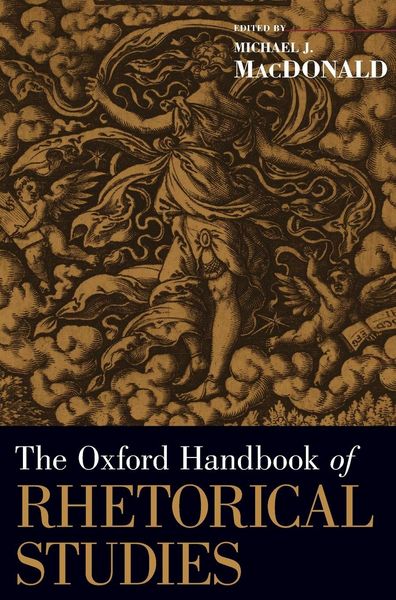
Produktbild: Oxford Handbook of Rhetorical Studies

Oxford Handbook of Rhetorical Studies

Aus der Reihe Oxford Handbooks

Fr. 273.00

inkl. gesetzl. MwSt., Versandkostenfrei


Beschreibung

One of the most remarkable trends in the humanities and social sciences in recent decades has been the resurgence of interest in the history, theory, and practice of rhetoric: in an age of global media networks and viral communication, rhetoric is once again contagious and communicable (Friedrich Nietzsche)....

Beschreibung

One of the most remarkable trends in the humanities and social sciences in recent decades has been the resurgence of interest in the history, theory, and practice of rhetoric: in an age of global media networks and viral communication, rhetoric is once again contagious and communicable (Friedrich Nietzsche). Featuring sixty commissioned chapters by eminent scholars of rhetoric from twelve countries, The Oxford Handbook of Rhetorical Studies offers students and teachers an engaging and sophisticated introduction to the multidisciplinary field of rhetorical studies. The Handbook traces the history of Western rhetoric from ancient Greece and Rome to the present and surveys the role of rhetoric in more than thirty academic disciplines and fields of social practice. This combination of historical and topical approaches allows readers to chart the metamorphoses of rhetoric over the centuries while mapping the connections between rhetoric and law, politics, science, education, literature, feminism, poetry, composition, philosophy, drama, criticism, digital media, art, semiotics, architecture, and other fields. Chapters provide the information expected of a handbook-discussion of key concepts, texts, authors, problems, and critical debates-while also posing challenging questions and advancing new arguments. In addition to offering an accessible and comprehensive introduction to rhetoric in the European and North American context, the Handbook includes a timeline of major works of rhetorical theory, translations of all Greek and Latin passages, extensive cross-referencing between chapters, and a glossary of more than three hundred rhetorical terms. These features will make this volume a valuable scholarly resource for students and teachers in rhetoric, English, classics, comparative literature, media studies, communication, and adjacent fields. As a whole, the Handbook demonstrates that rhetoric is not merely a form of stylish communication but a pragmatic, inventive, and critical art that operates in myriad social contexts and academic disciplines.

Produktdetails

Einband

Gebundene Ausgabe

Erscheinungsdatum

18.10.2017

Abbildungen

8 b&w line art, 5 halftones

Herausgeber Michael J. MacDonald + weitere

Produktdetails

Einband

Gebundene Ausgabe

Erscheinungsdatum

18.10.2017

Abbildungen

8 b&w line art, 5 halftones

Herausgeber
Verlag Oxford Academic
Seitenzahl

844

Maße (L/B/H)

25/17.5/4.9 cm

Gewicht

1607 g

Sprache

Englisch

ISBN

978-0-19-973159-6

Herstelleradresse

Libri GmbH
Europaallee 1
36244 Bad Hersfeld
DE

Email: gpsr@libri.de

Noch keine Bewertungen vorhanden

Verfassen Sie die erste Bewertung zu diesem Artikel

Helfen Sie anderen Kundinnen und Kunden durch Ihre Meinung.

Kundinnen und Kunden meinen

Bewertungen (0)

Die Leseprobe wird geladen.
  • Produktbild: Oxford Handbook of Rhetorical Studies
    • Contents
    • List of Contributors
    • Timeline
    • Introduction
    • Michael J. MacDonald
    • Part I: Ancient Greek Rhetoric
    • 1. The Development of Greek Rhetoric
    • Edward Schiappa
    • 2. Rhetoric and Law
    • Michael Gagarin
    • 3. Rhetoric and Politics
    • Edward Harris
    • 4. Rhetoric and Historiography
    • Chris Carey
    • 5. Rhetoric and Pedagogy
    • Malcolm Heath
    • 6. Rhetoric and Poetics
    • Jeffrey Walker
    • 7. Rhetoric and Tragedy
    • Paul Woodruff
    • 8. Rhetoric and Old Comedy
    • Daphne O'Regan
    • 9. Plato's Rhetoric in Theory and Practice
    • Harvey Yunis
    • 10. Aristotle's Rhetoric in Theory and Practice
    • Eugene Garver
    • 11. Rhetoric and Sophistics
    • Barbara Cassin
    • Part II: Ancient Roman Rhetoric
    • 12. The Development of Roman Rhetoric
    • William J. Dominik
    • 13. Rhetoric and Law
    • Richard Leo Enos
    • 14. Rhetoric and Politics
    • Joy Connolly
    • 15. Rhetoric and Historiography
    • Rhiannon Ash
    • 16. Rhetoric and Pedagogy
    • Catherine Steel
    • 17. Rhetoric and Stoic Philosophy
    • Shadi Bartsch
    • 18. Rhetoric and Epic
    • Jon Hall
    • 19. Rhetoric and Lyric Address
    • Jonathan Culler
    • 20. Rhetoric and the Greco-Roman Second Sophistic
    • Laurent Pernot
    • 21. Rhetoric and Declamation
    • Erik Gunderson
    • 22. Rhetoric and Fiction
    • Ruth Webb
    • 23. Rhetoric, Music, and the Arts
    • Thomas Habinek
    • 24. Augustine's Rhetoric in Theory and Practice
    • Catherine Conybeare
    • Part III: Medieval Rhetoric
    • 25. The Development of Medieval Rhetoric
    • John O. Ward
    • 26. Rhetoric and Politics
    • Virginia Cox
    • 27. Rhetoric and Literary Criticism
    • Rita Copeland
    • 28. Rhetoric and Poetics
    • Jill Ross
    • 29. Rhetoric and Comedy
    • Jody Enders
    • Part IV: Renaissance Rhetoric
    • 30. Rhetoric and Humanism
    • Heinrich Plett
    • 31. Rhetoric and Politics
    • Wayne A. Rebhorn
    • 32. Rhetoric and Law
    • Lorna Hutson
    • 33. Rhetoric and Pedagogy
    • Peter Mack
    • 34. Rhetoric and Science
    • Jean Dietz Moss
    • 35. Rhetoric and Poetics
    • Arthur F. Kinney
    • 36. Rhetoric and Theater
    • Russ McDonald
    • 37. Rhetoric and the Visual Arts
    • Caroline van Eck
    • Part V: Early Modern and Enlightenment Rhetoric
    • 38. Rhetoric and Politics
    • Angus Gowland
    • 39. Rhetoric and Gender in British Literature
    • Lynn Enterline
    • 40. Rhetoric and Architecture
    • Robert Kirkbride
    • 41. Origins of British Enlightenment Rhetoric
    • Arthur Walzer
    • 42. Rhetoric and Philosophy
    • Adam Potkay
    • 43. Rhetoric and Science
    • Peter Walmsley
    • 44. The Elocutionary Movement in Britain
    • Paul Goring
    • Part VI: Modern and Contemporary Rhetoric
    • 45. Rhetoric and Feminism in the Nineteenth-Century United States
    • Angela G. Ray
    • 46. Rhetoric and Feminism
    • Cheryl Glenn and Andrea A. Lunsford
    • 47. Rhetoric and Race in the United States
    • Jacqueline Jones Royster
    • 48. Rhetoric and Law
    • Peter Goodrich
    • 49. Rhetoric and Political Theory
    • Andrew Norris
    • 50. Rhetoric and Presidential Politics
    • Karlyn Kohrs Campbell and Kathleen Hall Jamieson
    • 51. Rhetoric and New Testament Studies
    • Stanley E. Porter
    • 52. Rhetoric and Argumentation
    • Frans H. van Eemeren
    • 53. Rhetoric and Semiotics
    • Theo van Leeuwen
    • 54. Rhetoric and Psychoanalysis
    • Gilbert Chaitin
    • 55. Rhetoric and Deconstruction
    • Paul Allen Miller
    • 56. Rhetoric, Design, Composition
    • David Kaufer and Danielle Wetzel
    • 57. Rhetoric and Social Epistemology
    • Lorraine Code
    • 58. Rhetoric and Environment
    • Andrew McMurry
    • 59. Rhetoric and Science
    • Richard Doyle
    • 60. Rhetoric and Digital Media
    • Ian Bogost and Elizabeth Losh
    • Glossary
    • Index