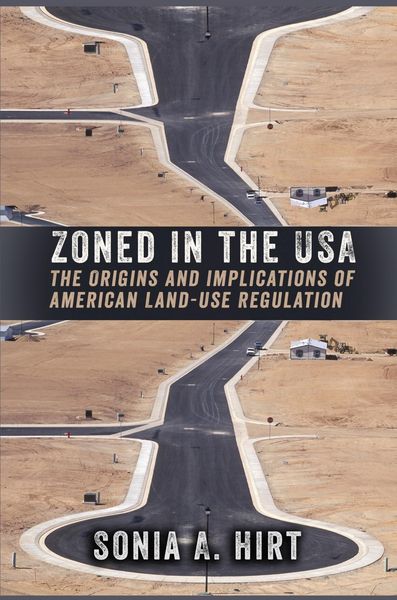
Zoned in the USA The Origins and Implications of American Land-Use Regulation
Fr. 20.90
inkl. gesetzl. MwSt.Beschreibung
Produktdetails
Format
ePUB
Kopierschutz
Nein
Family Sharing
Nein
Text-to-Speech
Ja
Erscheinungsdatum
24.02.2015
Verlag
Cornell University PressSeitenzahl
256 (Printausgabe)
Dateigröße
3609 KB
Sprache
Englisch
EAN
9780801454707
"[Hirt] provides a succinct overview of the history of zoning in the US. She compares zoning in the US to five European countries¿England, France, Sweden, Germany, and Russiäto highlight its distinctiveness. The story of American zoning reveals its origins in the early-20th century, fashioned to maintain property values and protect Americans' investments in their homes. The book tells the story of how local, state, and federal governments have contributed to the use of zoning to preserve the single-family detached home, connecting zoning to other policies, such as transportation and home loan financing. This is a terrific book for collections on housing, land use, zoning, and law."¿CHOICE
Why are American cities, suburbs, and towns so distinct? Compared to European cities, those in the United States are characterized by lower densities and greater distances; neat, geometric layouts; an abundance of green space; a greater level of social segregation reflected in space; and-perhaps most noticeably-a greater share of individual, single-family detached housing. In Zoned in the USA, Sonia A. Hirt argues that zoning laws are among the important but understudied reasons for the cross-continental differences.
Hirt shows that rather than being imported from Europe, U.S. municipal zoning law was in fact an institution that quickly developed its own, distinctly American profile. A distinct spatial culture of individualism-founded on an ideal of separate, single-family residences apart from the dirt and turmoil of industrial and agricultural production-has driven much of municipal regulation, defined land-use, and, ultimately, shaped American life.
Hirt explores municipal zoning from a comparative and international perspective, drawing on archival resources and contemporary land-use laws from England, Germany, France, Australia, Russia, Canada, and Japan to challenge assumptions about American cities and the laws that guide them.
Kundinnen und Kunden meinen
Verfassen Sie die erste Bewertung zu diesem Artikel
Helfen Sie anderen Kund*innen durch Ihre Meinung