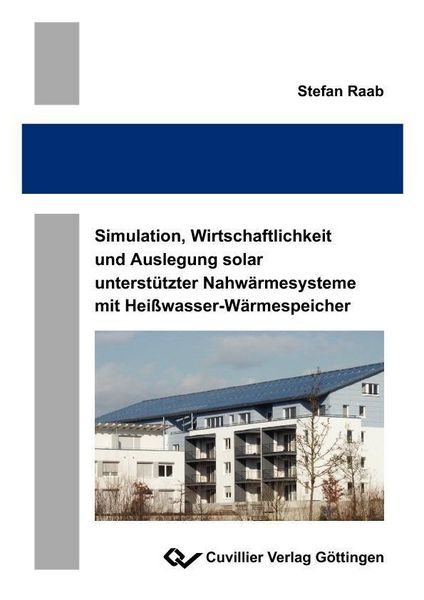
Simulation, Wirtschaftlichkeit und Auslegung solar unterstützter Nahwärmesysteme mit Heißwasser-Wärmespeicher
-
- Taschenbuch
- eBook ausgewählt
-
Form:Einzelkauf Download
-
Sprache:Deutsch
Fr. 23.90
inkl. gesetzl. MwSt.Beschreibung
Produktdetails
Format
Kopierschutz
Nein
Family Sharing
Ja
Text-to-Speech
Nein
Erscheinungsdatum
10.11.2006
Verlag
Cuvillier Verlag eBooksSeitenzahl
180 (Printausgabe)
Dateigröße
3323 KB
Sprache
Deutsch
EAN
9783736920484
Solar unterstützte Nahwärmesysteme mit solaren Deckungsanteilen von ca. 35% am Gesamtwärmebedarf ermöglichen die Substitution eines beträchtlichen Anteils fossiler Brennstoffe bei gleichzeitig moderaten Investitionskosten verglichen mit Systemen mit einem solaren Deckungsanteil von 50% durch den Verzicht auf eine saisonale Wärmespeicherung. Eine ausführliche Literaturstudie hat gezeigt, dass bisher keine Auslegungsrichtlinien für solar unterstützte Nahwärmesysteme mit erdvergrabenen oder oberirdischen Heisswasser-Wärmespeichern bei einem solaren Deckungsanteil von 35% existieren. Ziel dieser Arbeit war die Erstellung derartiger Dimensionierungsrichtlinien auf Basis der Ergebnisse umfangreicher Simulationsrechnungen. Zur realitätsnahen Simulation des thermischen Verhaltens typischer solar unterstützter Nahwärmenetze wurden zwei Wärmelasten mit jährlichen mittleren Vor- und Rücklauftemperaturen von 68/41 °C bzw. 60/30 °C aufgrund unterschiedlicher Systemtechnik zur Trinkwassererwärmung definiert. Zur Simulation der Wärmelast 68/41 zeigte sich ein in der Literatur beschriebenes Modell geeignet. Für die Wärmelast 60/30 wurde ein Simulationsmodell mit der TRNSYS-Software erstellt. Für beide Fälle wurden Validierungen anhand von Messdaten bestehender Nahwärmenetze durchgeführt. Die Anwendbarkeit des sogenannten XST-Modells für das Simulationsprogramm TRNSYS zur Berechnung des thermischen Verhaltens erdvergrabener Wärmespeicher wurde erstmals detailliert gezeigt. Zur Validierung wurden die Messdaten des Heisswasser-Wärmespeichers in Hannover (Volumen 2 795 m³) verwendet. Im Vergleich zu früheren Untersuchungen wurden erstmals die Temperaturen im umgebenden Erdreich und das thermische Verhalten der Verbindungsleitungen zwischen Heizzentrale und Wärmespeicher in Betracht gezogen. Die durch die Validierung erhaltenen Wärmeleitfähigkeiten von Wärmedämmung und Erdreich stimmen gut mit experimentellen Werten überein. Die gemessenen und berechneten Temperaturen im und um den Wärmespeicher (< ±3%) bzw. die Wärmemengen in den und aus dem Wärmespeicher stimmen gut überein (< ±2%). Eine Integration des XST-Modells in ein neu erstelltes TRNSYS-Modell zur Simulation des solar unterstützten Nahwärmesystems mit erdvergrabenem Heisswasser-Wärmespeicher in Hannover erbrachte Abweichungen berechneter und gemessener Wärmemengen von unter ±5%. Entsprechende Wärmemengen des ebenfalls neu erstellten TRNSYS-Modells zur Simulation des solar unterstützten Nahwärmesystems mit oberirdischem Heisswasser-Wärmespeicher in Gneis-Moos weichen um weniger als ±3% voneinander ab. Auf Basis der Ergebnisse der mit beiden Simulationsmodellen erstellten Sensitivitätsanalysen wurden zwei optimierte Referenzmodelle definiert und umfangreiche Simulationsläufe durchgeführt. Das thermische Verhalten solar unterstützter Nahwärmesysteme mit einem solaren Deckungsanteil von 35% wurde bei drei unterschiedlichen Klimaten (Hamburg, Frankfurt/M., Würzburg), verschiedenen Nahwärmenetztemperaturen und –grössen, verschiedenen Verhältnissen von Wärmespeichervolumen zu Kollektorfläche und von Kollektorfläche zu Wärmemenge des Nahwärmenetzes berechnet. Es zeigte sich, dass die solaren Wärmekosten von Systemen mit erdvergrabenem Wärmespeicher und der Wärmelast 60/30 bei einer Wärmemenge von 500 MWh/a im Nahwärmenetz gegenüber der Wärmelast 68/41 je nach Standort um 10%−12%, bei grösseren Systemen mit 10 000 MWh/a um 7%−9% niedriger sind. Die solaren Wärmekosten für Systeme am Standort Frankfurt betragen von 27,0 Ct./kWh (500 MWh/a; 68/41) bis 13,6 Ct./kWh (10 000 MWh/a; 68/41). Am Standort Würzburg sind die solaren Wärmekosten um 10%−14% niedriger, am Standort Hamburg bis zu 5% höher. Bei Systemen mit einer Wärmelast von 500 MWh/a können durch Tolerierung von Stagnationszeiten bis zu 100 Stunden Kosteneinsparungen von 13% gegenüber einer Referenzvariante ohne Stagnation erzielt werden. Die Simulationsstudie mit dem TRNSYS-Modell für Systeme mit oberirdischem Wärmespeicher erbrachte solare Wärmekosten von 22,8 Ct./kWh (500 MWh/a, 68/41) für den Standort Frankfurt bei Tolerierung von bis zu 100 h Stagnation. Auf Basis der Ergebnisse der Simulationsstudien beider TRNSYS-Modelle wurden umfassende Dimensionierungsrichtlinien unter Berücksichtigung von Standort, Grösse und Temperaturniveau des Nahwärmenetzes für Systeme mit erdvergrabenen oder oberirdischen Wärmespeichern erarbeitet. Die Resultate der Sensitivitätsanalysen ermöglichen die einfache Bestimmung der Auswirkungen einer Abweichung von den Referenzbedingungen auf den solaren Deckungsanteil. Es ist mit den Ergebnissen der Arbeit erstmals möglich, energie- und kosteneffiziente solar unterstützte Nahwärmesysteme mit einem solaren Deckungsanteil von 35% ohne aufwändige und kostenintensive dynamische Simulationen auszulegen.
Abstract
Solar assisted district heating systems with a solar fraction of 35% based on the total heat demand enable to save a significant amount of fossil fuels. Compared to systems with solar fractions of 50% the investment costs are moderate because seasonal heat storage is not required. Literature research showed that no design guidelines for solar assisted district heating systems with ground buried or aboveground hot water heat stores and a solar fraction of 35% are available up to now. The aim of this work was the generation of such guidelines based on the results of extensive dynamic simulations. For the simulation of the thermal behaviour of typical solar assisted district heating nets two heat loads with yearly average supply pipe and return pipe temperatures of 68/41 °C and 60/30 °C (different temperature levels due to the system technology of generation of domestic hot water) were defined. For the simulation of the case 68/41 a TRNSYS model described in the literature was found to be suitable. For the case 60/30 a TRNSYS simulation model was created. Both models were validated with measured data from existing district heating nets. The XST model for the detailed calculation of the thermal behaviour of ground buried heat stores with TRNSYS was validated with measured data of the hot water heat store in Hanover (volume of 2 795 m³). In contrast to previous investigations the temperatures of the surrounding ground and the thermal behaviour of the connecting pipes between heating central and heat store were also taken into consideration. The deviation between measured and calculated temperatures is less than ±3%. The measured and calculated heat loads are also in good agreement (annual deviation less than 2%). The validated XST-model was integrated into a new TRNSYS model to calculate the thermal behaviour of the solar assisted district heating system in Hanover in 2002. The deviations between measured and calculated heat loads do not exceed 5%. Corresponding heat loads of the newly-created TRNSYS model for the simulation of the solar assisted district heating system with the aboveground hot water heat store in Gneis-Moos deviate less than ±3%. Two optimised reference models were defined based on the results of sensitivity analysis performed with the above solar assisted district heating system models. Subsequently, extensive simulation studies were carried out. The thermal behaviour of solar assisted district heating systems with a solar fraction of 35% was calculated for three different German climates (i. e. Hamburg, Frankfurt/Main, Würzburg), various district heating net temperatures and heat loads, different ratios of heat store volume to collector area and different ratios of collector area to heat load of the district heating net. As a result, solar heat costs of systems with ground buried heat store and heat duty type 60/30 (500 MWh/a) are 10% to 12% lower compared to heat duty type 68/41 depending on the location. For large systems (10 000 MWh/a) the difference is between 7% and 9%. The solar heat costs for systems in Frankfurt range from 27.0 €Ct./kWh (500 MWh/a, 68/41) to 13.6 €Ct./kWh (10 000 MWh/a, 68/41). For systems in Würzburg the costs are from 10% to 14% lower, for systems in Hamburg up to 5% higher. Cost reductions of about 13% are possible for systems with a heat load of 500 MWh/a by accepting stagnation times of up to 100 hours compared to the reference system without stagnation. The simulation study with the TRNSYS model for systems with aboveground heat store resulted in solar heat costs of 22.8 €Ct./kWh (500 MWh/a, 68/41) for Frankfurt systems and stagnation times of up to 100 h. Based on the results of the simulation studies carried out with both TRNSYS system models, design guidelines have been worked out. These guidelines take into consideration the location, and the heat load and temperature level of the district heating net for systems with ground buried and aboveground heat stores. The results of the sensitivity analysis allow simple evaluation of the influence of a deviation from the reference boundary conditions on the solar fraction. The results of this work allow for the first time designing energy and cost-efficient solar assisted district heating systems with a solar fraction of 35% without complex and costly dynamic simulations over a wide range of parametrics.
Abstract
Solar assisted district heating systems with a solar fraction of 35% based on the total heat demand enable to save a significant amount of fossil fuels. Compared to systems with solar fractions of 50% the investment costs are moderate because seasonal heat storage is not required. Literature research showed that no design guidelines for solar assisted district heating systems with ground buried or aboveground hot water heat stores and a solar fraction of 35% are available up to now. The aim of this work was the generation of such guidelines based on the results of extensive dynamic simulations. For the simulation of the thermal behaviour of typical solar assisted district heating nets two heat loads with yearly average supply pipe and return pipe temperatures of 68/41 °C and 60/30 °C (different temperature levels due to the system technology of generation of domestic hot water) were defined. For the simulation of the case 68/41 a TRNSYS model described in the literature was found to be suitable. For the case 60/30 a TRNSYS simulation model was created. Both models were validated with measured data from existing district heating nets. The XST model for the detailed calculation of the thermal behaviour of ground buried heat stores with TRNSYS was validated with measured data of the hot water heat store in Hanover (volume of 2 795 m³). In contrast to previous investigations the temperatures of the surrounding ground and the thermal behaviour of the connecting pipes between heating central and heat store were also taken into consideration. The deviation between measured and calculated temperatures is less than ±3%. The measured and calculated heat loads are also in good agreement (annual deviation less than 2%). The validated XST-model was integrated into a new TRNSYS model to calculate the thermal behaviour of the solar assisted district heating system in Hanover in 2002. The deviations between measured and calculated heat loads do not exceed 5%. Corresponding heat loads of the newly-created TRNSYS model for the simulation of the solar assisted district heating system with the aboveground hot water heat store in Gneis-Moos deviate less than ±3%. Two optimised reference models were defined based on the results of sensitivity analysis performed with the above solar assisted district heating system models. Subsequently, extensive simulation studies were carried out. The thermal behaviour of solar assisted district heating systems with a solar fraction of 35% was calculated for three different German climates (i. e. Hamburg, Frankfurt/Main, Würzburg), various district heating net temperatures and heat loads, different ratios of heat store volume to collector area and different ratios of collector area to heat load of the district heating net. As a result, solar heat costs of systems with ground buried heat store and heat duty type 60/30 (500 MWh/a) are 10% to 12% lower compared to heat duty type 68/41 depending on the location. For large systems (10 000 MWh/a) the difference is between 7% and 9%. The solar heat costs for systems in Frankfurt range from 27.0 €Ct./kWh (500 MWh/a, 68/41) to 13.6 €Ct./kWh (10 000 MWh/a, 68/41). For systems in Würzburg the costs are from 10% to 14% lower, for systems in Hamburg up to 5% higher. Cost reductions of about 13% are possible for systems with a heat load of 500 MWh/a by accepting stagnation times of up to 100 hours compared to the reference system without stagnation. The simulation study with the TRNSYS model for systems with aboveground heat store resulted in solar heat costs of 22.8 €Ct./kWh (500 MWh/a, 68/41) for Frankfurt systems and stagnation times of up to 100 h. Based on the results of the simulation studies carried out with both TRNSYS system models, design guidelines have been worked out. These guidelines take into consideration the location, and the heat load and temperature level of the district heating net for systems with ground buried and aboveground heat stores. The results of the sensitivity analysis allow simple evaluation of the influence of a deviation from the reference boundary conditions on the solar fraction. The results of this work allow for the first time designing energy and cost-efficient solar assisted district heating systems with a solar fraction of 35% without complex and costly dynamic simulations over a wide range of parametrics.
Noch keine Bewertungen vorhanden
Verfassen Sie die erste Bewertung zu diesem Artikel
Helfen Sie anderen Kundinnen und Kunden durch Ihre Meinung.