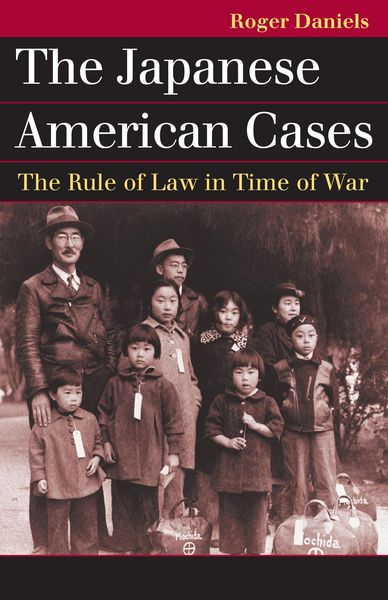
The Japanese American Cases The Rule of Law in Time of War
-
- Taschenbuch
- eBook ausgewählt
-
Form:Einzelkauf Download
-
Sprache:Englisch
Fr. 33.90
inkl. gesetzl. MwSt.Beschreibung
Produktdetails
Format
ePUB
Kopierschutz
Nein
Family Sharing
Nein
Text-to-Speech
Ja
Erscheinungsdatum
11.04.2014
Verlag
University Press of KansasSeitenzahl
240 (Printausgabe)
Dateigröße
1146 KB
Sprache
Englisch
EAN
9780700619740
After Pearl Harbor, President Roosevelt, claiming a never documented military necessity, ordered the removal and incarceration of 120,000 Japanese Americans during World War II solely because of their ancestry. As Roger Daniels movingly describes, almost all reluctantly obeyed their government and went peacefully to the desolate camps provided for them.
Daniels, however, focuses on four Nisei, second-generation Japanese Americans, who, aided by a handful of lawyers, defied the government and their own community leaders by challenging the constitutionality of the government's orders. The 1942 convictions of three menMin Yasui, Gordon Hirabayashi, and Fred Korematsuwho refused to go willingly were upheld by the Supreme Court in 1943 and 1944. But a woman, Mitsuye Endo, who obediently went to camp and then filed for a writ of habeas corpus, won her case. The Supreme Court subsequently ordered her release in 1944, following her two and a half years behind barbed wire.
Neither the cases nor the fate of law-abiding Japanese attracted much attention during the turmoil of global warfare; in the postwar decades they were all but forgotten. Daniels traces how, four decades after the war, in an America whose attitudes about race and justice were changing, the surviving Japanese Americans achieved a measure of political and legal justice. Congress created a commission to investigate the legitimacy of the wartime incarceration. It found no military necessity, but rather that the causes were race prejudice, war hysteria, and a failure of political leadership. In 1982 it asked Congress to apologize and award $20,000 to each survivor. A bill providing that compensation was finally passed and signed into law in 1988.
There is no way to undo a Supreme Court decision, but teams of volunteer lawyers, overwhelmingly Sanseithird-generation Japanese Americansused revelations in 1983 about the suppression of evidence by federal attorneys to persuade lower courts to overturn the convictions of Hirabayashi and Korematsu.
Daniels traces the continuing changes in attitudes since the 1980s about the wartime cases and offers a sobering account that resonates with present-day issues of national security and individual freedom.
Noch keine Bewertungen vorhanden
Verfassen Sie die erste Bewertung zu diesem Artikel
Helfen Sie anderen Kundinnen und Kunden durch Ihre Meinung.