• Produktbild: Money, Commerce, and Economics in Late Medieval English Literature
  • Produktbild: Money, Commerce, and Economics in Late Medieval English Literature

Money, Commerce, and Economics in Late Medieval English Literature

Aus der Reihe The New Middle Ages

Fr. 150.00

inkl. gesetzl. MwSt., Versandkostenfrei


Beschreibung

Produktdetails

Einband

Gebundene Ausgabe

Erscheinungsdatum

16.02.2018

Abbildungen

X, 1 illus. in color., farbige Illustrationen

Herausgeber

Craig E. Bertolet + weitere

Verlag

Springer

Seitenzahl

185

Maße (L/B/H)

21.6/15.3/1.6 cm

Gewicht

350 g

Auflage

1st ed. 2018

Sprache

Englisch

ISBN

978-3-319-71899-6

Beschreibung

Rezension

“This collection of rather short articles succeeds in revealing the increasing seriousness with which literary scholars of the late medieval period approach the socio-economic contexts in which their literature is produced. At the same time, it reveals their continuing success in excavating and bringing to light the myriad reflections of these contexts in the literature they study.” (Joel Kaye, The Medieval Review, May 20, 2020)

“This collection is a valuable survey of recent trends in economic approaches to Middle English literature, with contributions by a number of well-known scholars in the field as well as emerging voices. … Most importantly, in the imagination and theoretical boldness that its contributors bring to bear, the book suggests how to do this scholarship well.” (Walter Wadiak, The Review of English Studies, October 30, 2018)

Portrait

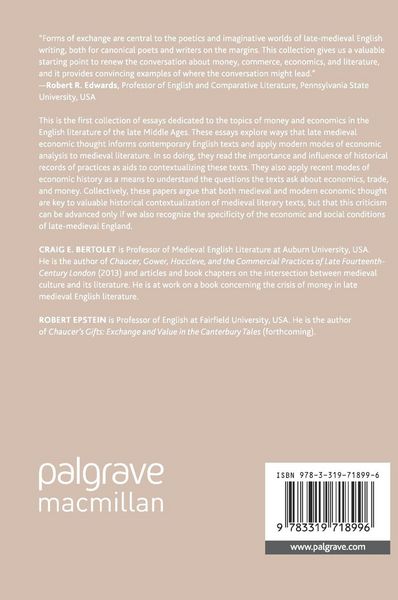
Craig E. Bertolet is Professor of Medieval English Literature at Auburn University, USA. He is the author of Chaucer, Gower, Hoccleve, and the Commercial Practices of Late Fourteenth-Century London (2013) and articles and book chapters on the intersection between medieval culture and its literature. He is at work on a book concerning the crisis of money in late medieval English literature.

Robert Epstein is Professor of English at Fairfield University, USA. He is the author of Chaucer’s Gifts: Exchange and Value in the Canterbury Tales (forthcoming). 

Produktdetails

Einband

Gebundene Ausgabe

Erscheinungsdatum

16.02.2018

Abbildungen

X, 1 illus. in color., farbige Illustrationen

Herausgeber

Verlag

Springer

Seitenzahl

185

Maße (L/B/H)

21.6/15.3/1.6 cm

Gewicht

350 g

Auflage

1st ed. 2018

Sprache

Englisch

ISBN

978-3-319-71899-6

Herstelleradresse

Springer-Verlag GmbH
Tiergartenstr. 17
69121 Heidelberg
DE

Email: ProductSafety@springernature.com

Noch keine Bewertungen vorhanden

Verfassen Sie die erste Bewertung zu diesem Artikel

Helfen Sie anderen Kundinnen und Kunden durch Ihre Meinung.

Kundinnen und Kunden meinen

Bewertungen (0)

  • Produktbild: Money, Commerce, and Economics in Late Medieval English Literature
  • Produktbild: Money, Commerce, and Economics in Late Medieval English Literature
  • 1 Introduction: "Greet press at market": Money Matters in Late Medieval English Literature.- 2 Judas and the Economics of Salvation in Medieval English Literature.- 3 “Whoso wele schal wyn, a wastour moste he fynde": Inter-reliant Economies and Social Capital in Wynnere and Wastoure.-  4   “The ryche man hatz more nede thanne the pore": Economics and Dependence in Dives and Paup er. - 5   Summoning Hunger: Polanyi, Piers Plowman , and the Labor Market.- 6 Demonic Ambiguity: Debt in the Friar-Summoner Sequence.- 7 Death is Money: Buying Trouble with the Pardoner.- 8: My Purse and My Person: "The Complaint of Chaucer to His Purse" and the Gender of Money.- 9 The Need for Economy: Poetic Identity and Trade in Gower’s Confessio Amantis.-  10: “Money Earned; Money Won": The Problem of Labor Pricing in Gower’s "Tale of the King and the Steward’s Wife".- 11 Crossing the Threshold: Geoffrey Chaucer, Adam Smith, and the Liminal Transactionalism of the Later Middle Ages.