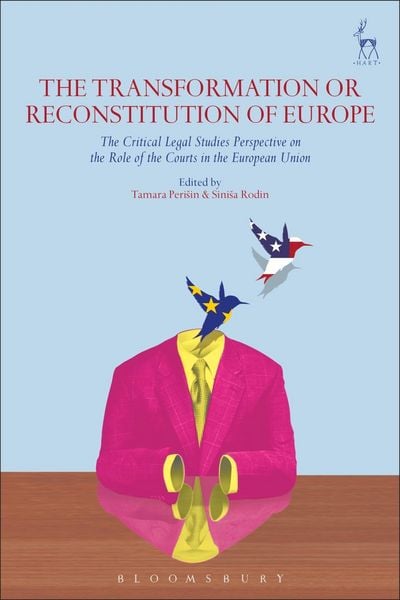
The Transformation or Reconstitution of Europe The Critical Legal Studies Perspective on the Role of the Courts in the European Union
-
Form:Einzelkauf Download
-
Sprache:Englisch
-
eBook Format:PDF
- PDF Fr. 45.90 ausgewählt
- ePUB Fr. 44.90
Fr. 45.90
inkl. gesetzl. MwSt.Beschreibung
Produktdetails
Format
Kopierschutz
Ja
Family Sharing
Nein
Text-to-Speech
Nein
Erscheinungsdatum
08.03.2018
Herausgeber
Tamara Perisin + weitereVerlag
Bloomsbury eBooks UKSeitenzahl
256 (Printausgabe)
Dateigröße
3377 KB
Auflage
1. Auflage
Sprache
Englisch
EAN
9781509907267
It is generally understood that EU law as interpreted by the ECJ has not merely reconstituted the national legal matrix at the supranational level, but has also transformed Europe and shaken the well-established, often formalist, ways of thinking about law in the Member States. This innovative new study seeks to examine such a narrative through the lens of the American critical legal studies (CLS) perspective.
The introduction explains how the editors understand CLS and why its methodology is relevant in the European context. Part II examines whether and how judges embed policy choices or even ideologies in their decisions, and how to detect them. Part III assesses how the ECJ acts to ensure the legitimacy of its decisions, whether it resists implementing political ideologies, what the ideology of European integration is, and how the selection of judges influences these issues. Part IV uses the critical perspective to examine some substantive parts of EU law, rules on internal and external movement, and the European arrest warrant. It seeks to determine whether the role of the ECJ has really been transformative and whether that transformation is reversible. Part V considers the role of academics in shaping the narratives of EU integration.
The introduction explains how the editors understand CLS and why its methodology is relevant in the European context. Part II examines whether and how judges embed policy choices or even ideologies in their decisions, and how to detect them. Part III assesses how the ECJ acts to ensure the legitimacy of its decisions, whether it resists implementing political ideologies, what the ideology of European integration is, and how the selection of judges influences these issues. Part IV uses the critical perspective to examine some substantive parts of EU law, rules on internal and external movement, and the European arrest warrant. It seeks to determine whether the role of the ECJ has really been transformative and whether that transformation is reversible. Part V considers the role of academics in shaping the narratives of EU integration.
Noch keine Bewertungen vorhanden
Verfassen Sie die erste Bewertung zu diesem Artikel
Helfen Sie anderen Kundinnen und Kunden durch Ihre Meinung.