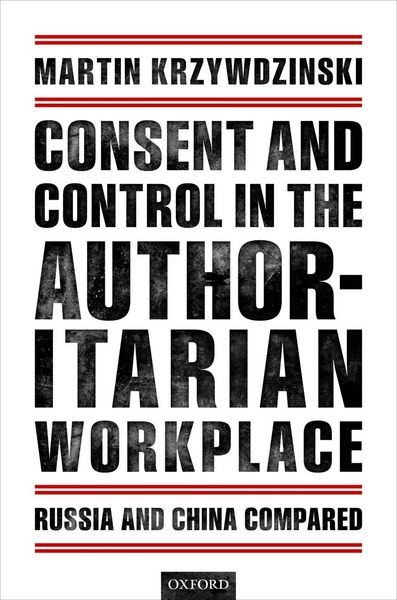
Consent and Control in the Authoritarian Workplace Russia and China Compared
-
Form:Einzelkauf Download
-
Sprache:Englisch
-
eBook Format:ePUB
- PDF Fr. 88.90
- ePUB Fr. 88.90 ausgewählt
Fr. 88.90
inkl. gesetzl. MwSt.Beschreibung
Produktdetails
Format
ePUB
Kopierschutz
Ja
Family Sharing
Nein
Text-to-Speech
Ja
Erscheinungsdatum
13.02.2018
Verlag
OUP eBookSeitenzahl
296 (Printausgabe)
Dateigröße
2318 KB
Sprache
Englisch
EAN
9780192529039
Today, a large proportion of the world's states are under authoritarian governments. These countries limit participation rights, both in the political sphere and in the workplace. At the same time, they have to generate consent in the workplace in order to ensure social stability and prevent the escalation of conflicts. But how do companies generate consent given that employee voice and interest representation may be limited or entirely absent?
Based on a review of research literature from sociology, organizational psychology, and behavioural economics, this book develops a theory of consent generation and distinguishes three groups of consent-producing mechanisms: socialization, incentive mechanisms, and participation and interest representation. It presents an empirical analysis of how these mechanisms work in Russian and Chinese automotive factories and shows how socio-cultural factors and labour regulation explain the differences between both countries regarding consent and control in the workplace.
The book contributes to two research debates. First, it examines the generation of consent in the workplace-a core topic of the sociology of work and organization. Its particular focus is on consent generation in authoritarian societies. Secondly, the book contributes to the debate about the reasons for the completely different trajectories of post-communist Russia and China. The book provides an empirical analysis that explains the different work behaviours of employees in both countries and links the micro-level of the workplace and the macro-level of institutions and organizational cultures.
Based on a review of research literature from sociology, organizational psychology, and behavioural economics, this book develops a theory of consent generation and distinguishes three groups of consent-producing mechanisms: socialization, incentive mechanisms, and participation and interest representation. It presents an empirical analysis of how these mechanisms work in Russian and Chinese automotive factories and shows how socio-cultural factors and labour regulation explain the differences between both countries regarding consent and control in the workplace.
The book contributes to two research debates. First, it examines the generation of consent in the workplace-a core topic of the sociology of work and organization. Its particular focus is on consent generation in authoritarian societies. Secondly, the book contributes to the debate about the reasons for the completely different trajectories of post-communist Russia and China. The book provides an empirical analysis that explains the different work behaviours of employees in both countries and links the micro-level of the workplace and the macro-level of institutions and organizational cultures.
Noch keine Bewertungen vorhanden
Verfassen Sie die erste Bewertung zu diesem Artikel
Helfen Sie anderen Kundinnen und Kunden durch Ihre Meinung.