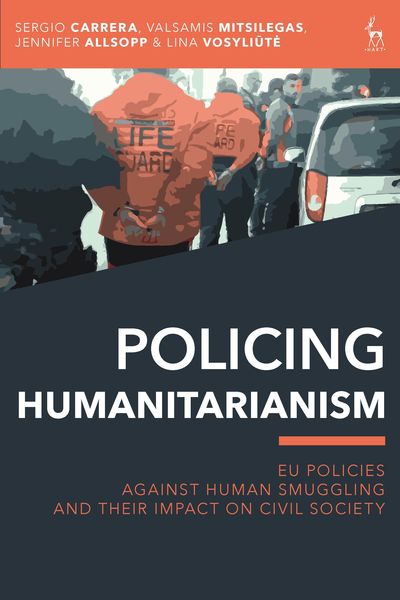
Policing Humanitarianism EU Policies Against Human Smuggling and their Impact on Civil Society
-
- Einzelkauf Download ausgewählt
-
Sprache:Englisch
-
eBook Format:ePUB
- PDF Fr. 40.90
- ePUB Fr. 40.90 ausgewählt
Fr. 40.90
inkl. gesetzl. MwSt.Beschreibung
Produktdetails
Format
ePUB
Kopierschutz
Ja
Family Sharing
Nein
Text-to-Speech
Ja
Erscheinungsdatum
24.01.2019
Verlag
Bloomsbury eBooks UKSeitenzahl
240 (Printausgabe)
Dateigröße
4173 KB
Auflage
1. Auflage
Sprache
Englisch
EAN
9781509923007
Policing Humanitarianism examines the ways in which European Union policies aimed at countering the phenomenon of migrant smuggling affects civil society actors' activities in the provision of humanitarian assistance, access to rights for irregular immigrants and asylum seekers. It explores the effects of EU policies, laws and agencies' operations in anti-migrant smuggling actions and their implementation in the following EU Member States: Italy, Greece, Hungary and the UK.The book critically studies policies designed and implemented since 2015, during the so called 'European refugee humanitarian crisis'.
Building upon the existing academic literature covering the 'criminalisation of migration ' in the EU, the book examines the wider set of punitive, coercive or control-oriented dynamics affecting Civil Society Actors' work and activities through the lens of the notion of ' policing the mobility society'. This concept seeks to provide a framework of analysis that allows for an examination of a wider set of practices, mechanisms and tools driven by a logic of policing in the context of the EU Schengen border framework: those which affect not only people, who move (qualified as third-country nationals for the purposes of EU law), but also people who mobilise in a rights-claiming capacity on behalf of and with immigrants and asylum-seekers.
Building upon the existing academic literature covering the 'criminalisation of migration ' in the EU, the book examines the wider set of punitive, coercive or control-oriented dynamics affecting Civil Society Actors' work and activities through the lens of the notion of ' policing the mobility society'. This concept seeks to provide a framework of analysis that allows for an examination of a wider set of practices, mechanisms and tools driven by a logic of policing in the context of the EU Schengen border framework: those which affect not only people, who move (qualified as third-country nationals for the purposes of EU law), but also people who mobilise in a rights-claiming capacity on behalf of and with immigrants and asylum-seekers.
Kundinnen und Kunden meinen
Verfassen Sie die erste Bewertung zu diesem Artikel
Helfen Sie anderen Kund*innen durch Ihre Meinung