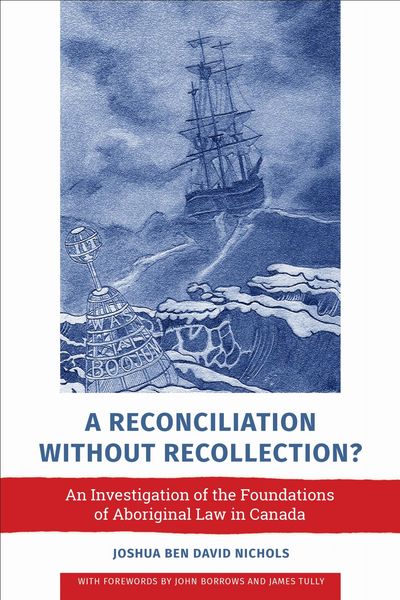
Produktbild: A Reconciliation without Recollection?

A Reconciliation without Recollection? An Investigation of the Foundations of Aboriginal Law in Canada

Fr. 79.90

inkl. gesetzl. MwSt., Versandkostenfrei


Beschreibung

Produktdetails

Einband

Taschenbuch

Erscheinungsdatum

01.02.2020

Verlag

University of Toronto Press

Seitenzahl

408

Maße (L/B/H)

22.6/15.2/2.3 cm

Gewicht

590 g

Sprache

Englisch

ISBN

978-1-4875-2187-5

Beschreibung

Rezension

"This book is an engrossing read for those interested in Aboriginal law, Canadian history, and decolonization."

- Andrea Black, Dentons Canada LLP (Canadian Law Library Review)

Produktdetails

Einband

Taschenbuch

Erscheinungsdatum

01.02.2020

Verlag

University of Toronto Press

Seitenzahl

408

Maße (L/B/H)

22.6/15.2/2.3 cm

Gewicht

590 g

Sprache

Englisch

ISBN

978-1-4875-2187-5

Herstelleradresse

Libri GmbH
Europaallee 1
36244 Bad Hersfeld
DE

Email: gpsr@libri.de

Kundinnen und Kunden meinen

0 Bewertungen

Informationen zu Bewertungen

Zur Abgabe einer Bewertung ist eine Anmeldung im Konto notwendig. Die Authentizität der Bewertungen wird von uns nicht überprüft. Wir behalten uns vor, Bewertungstexte, die unseren Richtlinien widersprechen, entsprechend zu kürzen oder zu löschen.

Die Bewertungen sind nach Format, Anzahl Sterne und Datum sortiert.

Verfassen Sie die erste Bewertung zu diesem Artikel

Helfen Sie anderen Kund*innen durch Ihre Meinung

Kundinnen und Kunden meinen

0 Bewertungen filtern

  • Produktbild: A Reconciliation without Recollection?
  • Foreword
    John Borrows

    Foreword
    James Tully

    Preface
    Acknowledgments

    Introduction

    Part 1 Reconciliation without Recollection

    1.1 Reconciliation in Canadian Jurisprudence
    1.2 Reconciliation as Picture Thinking
    A) Historicism
    B) The Ship of State
    1.3 History, Law, and Legitimacy
    1.4 Problem of Reconciliation as Problem of Foundations
    1.5 A Genealogy of the Indian Act
       
    Part 2 A Genealogy of Reconciliation: Civilizing, Extinction, and Culturalism as the Discursive Foundations of the Indian Act

    2.1 Liberty and Legitimate Despotism: The Liberal-Imperialism of J.S. Mill
    2.2 The Science of Savage Character: The Uncivilized and Mill’s Philosophy of History
    A) Governing the Uncivilized: The Role of the Intermediate Body
    B) Peace, Order, and Good Government: Mill and the Indian Question
    2.3 Reading the Right of History: Universal History and the Extinction Thesis
    2.4 From Enfranchisement to Reconciliation: Culturalism and Indirect Rule

    Part 3 A Despotism for Dealing with Barbarians: A Survey of the Foundations of Indian Policy in Canada

    3.1 Pre-Confederation to the Indian Act of 1876
    A) Imperial Federalism
    B) Imperial Civilizing
    C) Assimilation and Indirect Rule
    D) Striation or Continuity?
    3.2 The Indian Question and the Dominion
    3.3 The Six Nations Status Case
    A) The Six Nations of the Grand River
    B) The League of Nations and the Mandate System
    C) The Documents
    3.4 A Building Crisis of Legitimacy

    Part 4 A Law without Measure for a Land without Citizens: The Indian Act in Canadian Jurisprudence

    4.1 The Authority of s.91(24)
    A) St Catherine’s Milling, s.91(24), and the Division of Powers
    B) Interjurisdictional Immunity and s.91(24)
    C) The Theory of Enclaves
    D) The Uncertain Measure of Indianness
    E) Section 88 and Provincial Law
    4.2 The Definition of Indians and the Authority of Bands                                         
    A) Legislative Origins
    B) The Judicial Definition of Indians
    C) The Judicial Definition of Bands
    D) Custom Band Councils and the Question of Jurisdiction
    4.3 Tsilhqot'in Nation and the Meaning of s.91(24)

    Part 5 An Era of Reconciliation, An Era of Indirect Rule: From the White Paper to the Full Box of Rights 

    5.1 The Hidden Player: Policy from Calder to the Indian Act, 1985
    A) Line One: Legislative Renovation
    B) Line Two: Land Claim Agreements
    C) Line Three: Constitutional Change
    D) The Penner Report 
    E) The Problem of Implementing the New Relationship
    F) The Era of Indirect Rule and the Mechanism of Deferral
    5.2 Reconciliation and Implementation
    A) Unsettling the Ship of State
    B) Recollection without Historicism
    C) Implementing Reconciliation-with-Recollection

    Select Bibliography
    Index