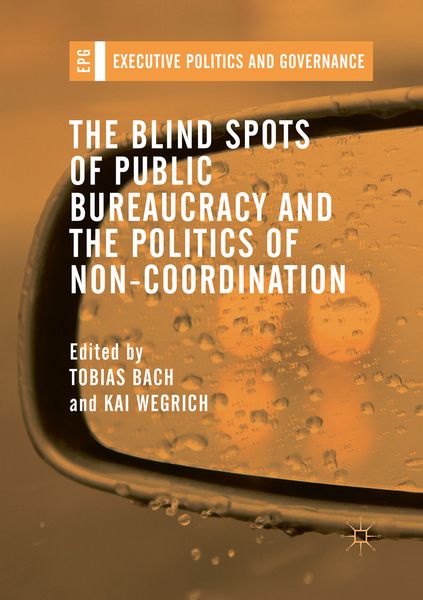
The Blind Spots of Public Bureaucracy and the Politics of Non‐Coordination
Aus der Reihe
Executive Politics and Governance
-
- Hardcover
- Taschenbuch ausgewählt
- eBook
-
Sprache:Englisch
Fr. 191.00
inkl. gesetzl. MwSt.,
Beschreibung
Produktdetails
Einband
Taschenbuch
Erscheinungsdatum
15.12.2018
Abbildungen
XVII, 269 p. 11 illus.
Herausgeber
Tobias Bach + weitereVerlag
SpringerSeitenzahl
269
Maße (L/B/H)
21/14.8/1.6 cm
Gewicht
376 g
Auflage
Softcover reprint of the original 1st edition 2019
Sprache
Englisch
ISBN
978-3-030-09552-9
How to better coordinate policies and public services across public sector organizations has been a major topic of public administration research for decades. However, few attempts have been made to connect these concerns with the growing body of research on biases and blind spots in decision-making. This book attempts to make that connection. It explores how day-to-day decision-making in public sector organizations is subject to different types of organizational attention biases that may lead to a variety of coordination problems in and between organizations, and sometimes also to major blunders and disasters. The contributions address those biases and their effects for various types of public organizations in different policy sectors and national contexts. In particular, it elaborates on blind spots, or ‘not seeing the not seeing’, and different forms of bureaucratic politics as theoretical explanations for seemingly irrational organizational behaviour. The book’s theoretical tools and empirical insights address conditions for effective coordination and problem-solving by public bureaucracies using an organizational perspective.
Noch keine Bewertungen vorhanden
Verfassen Sie die erste Bewertung zu diesem Artikel
Helfen Sie anderen Kundinnen und Kunden durch Ihre Meinung.