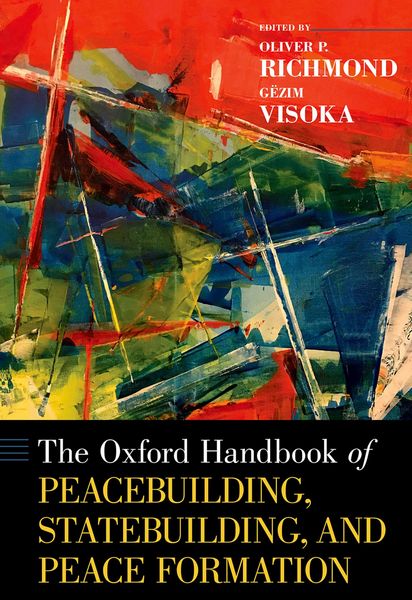
The Oxford Handbook of Peacebuilding, Statebuilding, and Peace Formation
-
Form:Einzelkauf Download
-
Sprache:Englisch
-
eBook Format:PDF
- PDF Fr. 136.90 ausgewählt
- ePUB Fr. 136.90
Fr. 136.90
inkl. gesetzl. MwSt.Beschreibung
Produktdetails
Format
Kopierschutz
Ja
Family Sharing
Nein
Text-to-Speech
Nein
Erscheinungsdatum
31.05.2021
Herausgeber
Oliver P. Richmond + weitereVerlag
OUP eBookSeitenzahl
672 (Printausgabe)
Dateigröße
28117 KB
Sprache
Englisch
EAN
9780190904425
In addition to being a major area of research within International Relations, peacebuilding and statebuilding is a major policy area within the UN and other international and regional organizations. It is also a concern of international financial institutions, including the World Bank, and a significant factor in the foreign and security policies of many established and emerging democracies. Peacebuilding and statebuilding are among the main approaches for preventing, managing, and mitigating global insecurities; dealing with the humanitarian consequences of civil wars; and expanding democracy and neoliberal economic regimes. Peace formation is a relatively new concept, addressing how local actors work in parallel to international and national projects, and helps shape the legitimacy of peace processes and state reform. The Oxford Handbook of Peacebuilding, Statebuilding, and Peace Formation serves as an essential guide to this vast intellectual and policy landscape. It offers a systematic overview of conceptual foundations, political implications, and tensions at the global, regional, and local levels, as well as key policies, practices, examples, and discourses underlining all segments of peacebuilding and statebuilding praxis. Approaching peacebuilding from disciplinary perspectives across the social sciences, the Handbook is organized around four major thematic sections. Section one explores how peacebuilding, statebuilding, and peace formation is conceived by different disciplines and IR approaches, thus offering an overview of the conceptual bedrock of major theories and approaches. Section two situates these approaches among other major global issues, including globalization, civil society, terrorism, and technology to illustrate their global, regional, and local resonance. Section three looks at key themes in the field, including peace agreements, democratization, security reform, human rights, environment, and culture. Finally, section four looks at key features of everyday and civil society peace formation processes, both in theory and in practice.
Noch keine Bewertungen vorhanden
Verfassen Sie die erste Bewertung zu diesem Artikel
Helfen Sie anderen Kundinnen und Kunden durch Ihre Meinung.