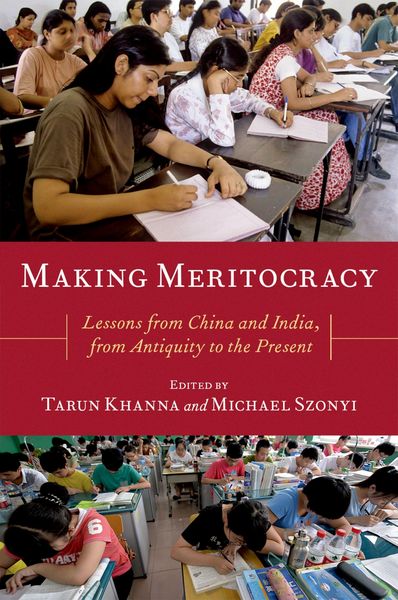
Making Meritocracy Lessons from China and India, from Antiquity to the Present
Aus der Reihe
Modern South Asia
-
- Hardcover
- Taschenbuch
- eBook ausgewählt
-
Form:Einzelkauf Download
-
Sprache:Englisch
-
eBook Format:PDF
- PDF Fr. 31.90 ausgewählt
- ePUB Fr. 31.90
Fr. 31.90
inkl. gesetzl. MwSt.Beschreibung
Produktdetails
Format
Kopierschutz
Ja
Family Sharing
Nein
Text-to-Speech
Nein
Erscheinungsdatum
19.07.2022
Herausgeber
Tarun Khanna + weitereVerlag
OUP eBookSeitenzahl
(Printausgabe)
Dateigröße
5001 KB
Sprache
Englisch
EAN
9780197602485
How do societies identify and promote merit? Enabling all people to fulfill their potential, and ensuring the selection of competent and capable leaders are central challenges for any society. These are not new concerns. Scholars, educators, and political and economic elites in China and India have been pondering them for centuries and continue to do so today, with enormously high stakes. In Making Meritocracy, Tarun Khanna and Michael Szonyi have gathered over a dozen experts from a range of intellectual perspectives--political science, history, philosophy, anthropology, economics, and applied mathematics--to discuss how the two most populous societies in the world have addressed the issue of building meritocracy historically, philosophically, and in practice. They focus on how contemporary policy makers, educators, and private-sector practitioners seek to promote it today. Importantly, they also discuss Singapore, which is home to large Chinese and Indian populations and the most successful meritocracy in recent times. Both China and India look to it for lessons. Though the past, present, and future of meritocracy building in China and India have distinctive local inflections, their attempts to enhance their power, influence, and social well-being by prioritizing merit-based advancement offers rich lessons both for one another and for the rest of the world--including rich countries like the United States, which are currently witnessing broad-based attacks on the very idea of meritocracy.
Noch keine Bewertungen vorhanden
Verfassen Sie die erste Bewertung zu diesem Artikel
Helfen Sie anderen Kundinnen und Kunden durch Ihre Meinung.