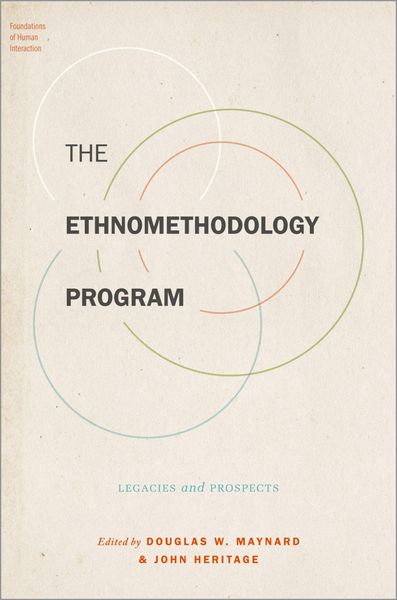
The Ethnomethodology Program Legacies and Prospects
Aus der Reihe
Foundations of Human Interacti
-
- Hardcover
- Taschenbuch
- eBook ausgewählt
-
Form:Einzelkauf Download
-
Sprache:Englisch
-
eBook Format:ePUB
- PDF Fr. 47.90
- ePUB Fr. 47.90 ausgewählt
Fr. 47.90
inkl. gesetzl. MwSt.Beschreibung
Produktdetails
Format
ePUB
Kopierschutz
Ja
Family Sharing
Nein
Text-to-Speech
Ja
Erscheinungsdatum
06.08.2022
Herausgeber
Douglas W. Maynard + weitereVerlag
OUP eBookSeitenzahl
464 (Printausgabe)
Dateigröße
17766 KB
Sprache
Englisch
EAN
9780190854430
It's been more than fifty years since Harold Garfinkel created the field of ethnomethodology--a discipline that offers a new way of understanding how people make sense of their everyday world. Since his book Studies in Ethnomethodology published in 1967, there has been a substantial--although often subterranean--growth in ethnomethodological (EM) work. Studies in and appreciation of ethnomethodological work continue to grow, but the breadth and penetration of his insights and inspiration for ongoing research have yet to secure their full measure of recognition. This volume celebrates Harold Garfinkel's enormous contributions to sociology and conversation analysis, exploring how ethnomethodology emerged, the empirical consequences of Garfinkel's work, and the significant contemporary work that has resulted from it. Douglas W. Maynard and John Heritage bring together experts from a wide range of theoretical and empirical areas to create the first comprehensive collection of work on EM that encompasses its role in "studies of work," in Conversation Analysis, and in other subdisciplines. Chapters highlight ethnomethodology's distinctive forms of ethnographic inquiry and its influences on a host of substantive domains including legal environments, science and technology, workplace and organizational inquiries, survey research, social problems and deviance, and disability and atypical interaction. The book explains how EM especially helped to set the agenda for gender studies, while also developing insights for inquiries into racial and ethnic features of everyday life and experience. Still, there is much of what Garfinkel called "unfinished business," which means that ethnomethodological inquiries are continuing to intensify and develop. Harold Garfinkel and Ethnomethodology ddresses this unfinished business: not only drawing attention to past accomplishments in the field, but also suggesting how these accomplishments set the stage for future endeavors that will benefit from EM-inspired approaches to social organization and interaction.
Noch keine Bewertungen vorhanden
Verfassen Sie die erste Bewertung zu diesem Artikel
Helfen Sie anderen Kundinnen und Kunden durch Ihre Meinung.