
KI-Beratung Beta

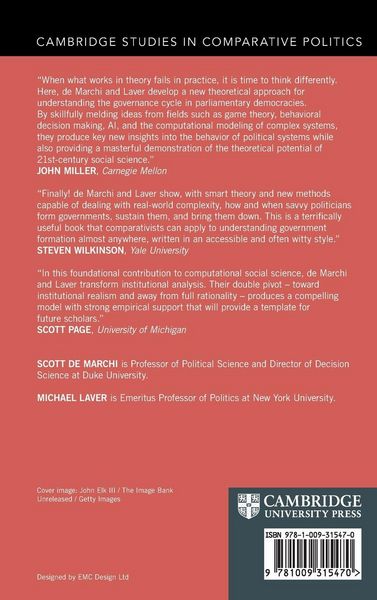
  • Produktbild: The Governance Cycle in Parliamentary Democracies
  • Produktbild: The Governance Cycle in Parliamentary Democracies

The Governance Cycle in Parliamentary Democracies A Computational Social Science Approach

Fr. 145.00

inkl. gesetzl. MwSt., Versandkostenfrei


Beschreibung

"This book analyzes government formation and survival in parliamentary democracies, for the first time using computational models to do this. We model "functionally rational' politicians who attack complex problems using simple rules of thumb, and develop artificial intelligence algorithms, similar to...

Beschreibung

"This book analyzes government formation and survival in parliamentary democracies, for the first time using computational models to do this. We model "functionally rational' politicians who attack complex problems using simple rules of thumb, and develop artificial intelligence algorithms, similar to those which have beaten the world's best poker players, which relentlessly learn how best to "win" the political game"--

Produktdetails

Einband

Gebundene Ausgabe

Erscheinungsdatum

09.02.2023

Verlag Cambridge University Press
Seitenzahl

228

Produktdetails

Einband

Gebundene Ausgabe

Erscheinungsdatum

09.02.2023

Verlag Cambridge University Press
Seitenzahl

228

Maße (L/B/H)

22.9/15.2/1.8 cm

Gewicht

503 g

Sprache

Englisch

ISBN

978-1-00-931547-0

Herstelleradresse

Libri GmbH
Europaallee 1
36244 Bad Hersfeld
DE

Email: gpsr@libri.de

Noch keine Bewertungen vorhanden

Verfassen Sie die erste Bewertung zu diesem Artikel

Helfen Sie anderen Kundinnen und Kunden durch Ihre Meinung.

Kundinnen und Kunden meinen

Bewertungen (0)

Die Leseprobe wird geladen.
  • Produktbild: The Governance Cycle in Parliamentary Democracies
  • Produktbild: The Governance Cycle in Parliamentary Democracies
  • Introduction; 1. Governance, complexity, computation and rationality; 2. The governance cycle; 3. Agent based model of government formation and survival; 4. Artificial intelligence and government formation; 5. Analyzing models of government formation and survival; 6. The empirics of government formation and survival; 7. Conclusions and aspirations; Appendices.