Band 14
Post-translational modification and regulation of oxophytodienoate reductase 3 (OPR3)
Aus der Reihe
Physiologie und Biotechnologie der Pflanzen
Fr. 58.90
inkl. gesetzl. MwSt.Beschreibung
Produktdetails
Format
Kopierschutz
Nein
Family Sharing
Ja
Text-to-Speech
Nein
Erscheinungsdatum
06.10.2022
Verlag
Cuvillier Verlag eBooksSeitenzahl
264 (Printausgabe)
Dateigröße
10113 KB
Sprache
Englisch
EAN
9783736966871
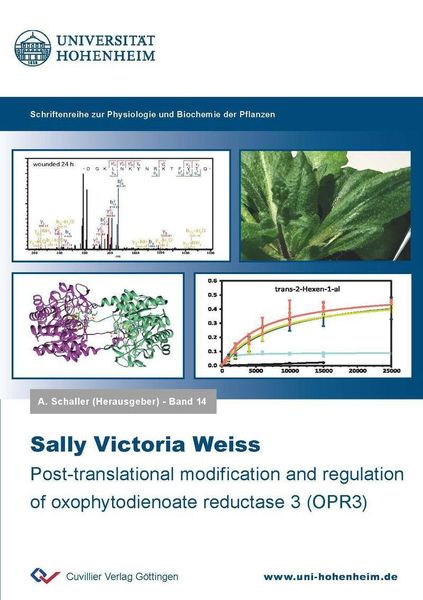
Oxophytodienoic acid reductases (OPRs) are flavoenzymes closely related to Old Yellow Enzyme (OYE) from Saccharomyces. The physiological role of plant OPRs could only be clarified for OPR3: OPR3 from tomato and Arabidopsis reduce the double bond of the α,β-unsaturated carbonyl group of (9S,13S)-oxophytodienoic acid (OPDA), the precursor of the phytohormone jasmonic acid (JA). OPR3 is therefore an important step for JA biosynthesis and the following JA-triggered defensive and developmental adaptations of the plant. Since the production of phytohormones, including JA, is regulated in an extremely time- and tissue specific manner, the regulatory step of JA-biosynthesis was sought. The conversion of OPDA by OPR3 was proposed as the rate-limiting step in biosynthesis as OPR3 turned out to form a self-inhibiting dimer when crystallized. In the OPR3 crystal, the L6-loop from each protomer reaches into the active site cavity of the other protomer. The dimerization-dependent block of the active site provides a hypothetical mechanism for the regulation of OPR3 activity. Interestingly, two sulfate ions were enclosed in the interacting site of the protomers, suggesting that the dimer might be stabilized in vivo by reversible sulfation or phosphorylation of the tyrosine 364(SlOPR3) or 365 (AtOPR3), respectively. The role of this hypothesized sulfation/phosphorylation was subject of this study.
Neither sulfation nor phosphorylation of Y365 could be detected by mass spectrometry. Hence, studies were continued with an in vitro approach where OPR3 was expressed with sulfotyrosine incorporated co-translationally at position 365 (Y365SY). Biochemical characterization led to contradictory results: On the one hand, interaction strength of Y365SY was unaltered in comparison to wild-type OPR3, while on the other hand, activity of Y365SY was reduced. Closer examination indicated that substrate binding or product release was reduced in Y365SY. These changes could be traced back to the additional charge of the SO42--ion, which leads to a narrowing of the entrance to the active site cavity. With this finding, the proposed regulating mechanism by sulfation/phosphorylation is still valid, but independent from dimerization.
In order to link this potential regulatory mechanism with a post-translational modification in vivo, an untargeted screen was performed, in which OPR3 was expressed as a fusion protein with a promiscous biotin ligase (BioID2). With this method, potentially interacting proteins were biotinylated in vivo and subsequently isolated and analyzed by MS/MS. Many candidate proteins were identified for OPR3, including kinases and phosphatases. Additionally, OPR1, OPR2 and OPR4 from Arabidopsis were also expressed as BioID2 fusion proteins in order to clarify their physiological role. The most promising results were obtained for OPR4, which was found to be association with stress granule and P-body proteins.
Neither sulfation nor phosphorylation of Y365 could be detected by mass spectrometry. Hence, studies were continued with an in vitro approach where OPR3 was expressed with sulfotyrosine incorporated co-translationally at position 365 (Y365SY). Biochemical characterization led to contradictory results: On the one hand, interaction strength of Y365SY was unaltered in comparison to wild-type OPR3, while on the other hand, activity of Y365SY was reduced. Closer examination indicated that substrate binding or product release was reduced in Y365SY. These changes could be traced back to the additional charge of the SO42--ion, which leads to a narrowing of the entrance to the active site cavity. With this finding, the proposed regulating mechanism by sulfation/phosphorylation is still valid, but independent from dimerization.
In order to link this potential regulatory mechanism with a post-translational modification in vivo, an untargeted screen was performed, in which OPR3 was expressed as a fusion protein with a promiscous biotin ligase (BioID2). With this method, potentially interacting proteins were biotinylated in vivo and subsequently isolated and analyzed by MS/MS. Many candidate proteins were identified for OPR3, including kinases and phosphatases. Additionally, OPR1, OPR2 and OPR4 from Arabidopsis were also expressed as BioID2 fusion proteins in order to clarify their physiological role. The most promising results were obtained for OPR4, which was found to be association with stress granule and P-body proteins.
Noch keine Bewertungen vorhanden
Verfassen Sie die erste Bewertung zu diesem Artikel
Helfen Sie anderen Kundinnen und Kunden durch Ihre Meinung.