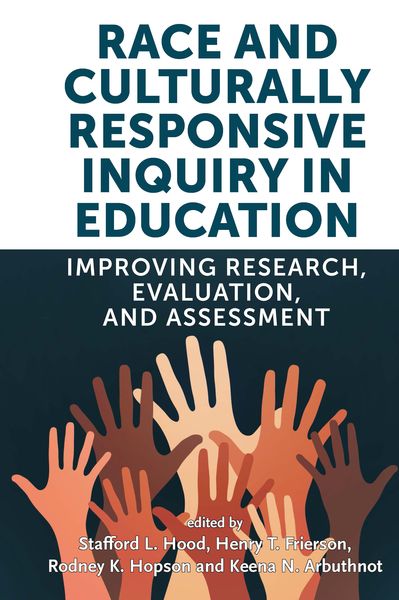
Race and Culturally Responsive Inquiry in Education Improving Research, Evaluation, and Assessment
-
- Taschenbuch
- eBook ausgewählt
-
Form:Einzelkauf Download
-
Sprache:Englisch
Fr. 30.90
inkl. gesetzl. MwSt.Beschreibung
Produktdetails
Format
ePUB
Kopierschutz
Nein
Family Sharing
Nein
Text-to-Speech
Ja
Erscheinungsdatum
16.08.2022
Herausgeber
Stafford L. Hood + weitereVerlag
Harvard Education PressSeitenzahl
264 (Printausgabe)
Sprache
Englisch
EAN
9781682537541
Race and Culturally Responsive Inquiry in Education examines how assumptions about race and culture have shaped US education research and the interpretation and implementation of its results.
This ambitious volume sheds light on the detrimental effects of educational praxis and policies that have characterized communities of color and historically underserved communities as deficient. It reveals how such bias has affected many facets of educational inquiry, from research design and planning to education policy making and evaluation practices. The provocative essays in this work challenge traditional suppositions about whose evidence matters, highlighting approaches for reframing educational inquiry and arguing for the adoption of a culturally responsive stance that can correct inequities by accounting for students' diverse backgrounds and needs.
Edited by Stafford L. Hood, Henry T. Frierson, Rodney K. Hopson, and Keena N. Arbuthnot and featuring contributions from leading and emerging scholars, the collection is organized around three key areas-education research, educational assessment, and program evaluation. The contributors identify provocative problems that exist at the intersection of race and education in these areas, and they illuminate the many ways in which education reform can address intersectionality. Calling for effective action, they suggest compelling solutions for consideration by policy makers and practitioners as well as researchers.
Together, the essays in this volume make the case that culturally responsive methods that deepen our understanding of educational disparities, appropriately measure what students know and can do, and ensure that we have accurate information about the effectiveness of educational interventions can improve educational outcomes for diverse learners.
Noch keine Bewertungen vorhanden
Verfassen Sie die erste Bewertung zu diesem Artikel
Helfen Sie anderen Kundinnen und Kunden durch Ihre Meinung.