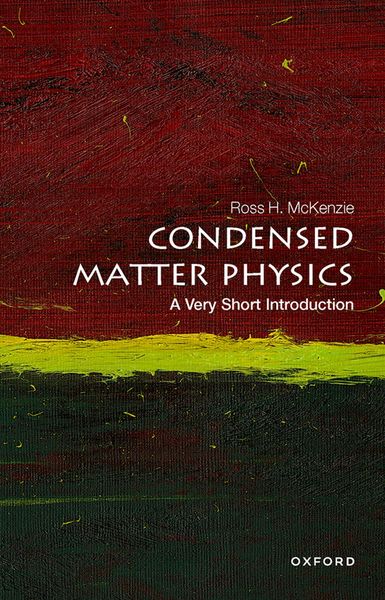
Condensed Matter Physics A Very Short Introduction
-
- Taschenbuch
- eBook ausgewählt
-
Form:Einzelkauf Download
-
Sprache:Englisch
-
eBook Format:PDF
- PDF Fr. 11.90 ausgewählt
- ePUB Fr. 11.90
Fr. 11.90
inkl. gesetzl. MwSt.Beschreibung
Produktdetails
Format
Kopierschutz
Ja
Family Sharing
Nein
Text-to-Speech
Nein
Erscheinungsdatum
10.05.2023
Verlag
Oxford University PressSeitenzahl
144 (Printausgabe)
Dateigröße
1407 KB
Sprache
Englisch
EAN
9780192584120
There are many more states of matter than just solid, liquid, and gas. Examples include liquid crystal, magnet, glass, and superconductor. New states are continually, and unexpectedly, being discovered. Some states, such as superconductor, can act like Schrödinger's cat and exhibit the weirdness normally associated with the quantum theory of atoms, photons, and electrons. Condensed matter physics seeks to understand how states of matter and their distinct physical properties emerge from the atoms of which a material is composed.
A system of many interacting parts can have properties that the parts do not have. Water is wet, but a single water molecule is not. Your brain is conscious, but a single neuron is not. Such emergent phenomena are central to condensed matter physics and also occur in many fields, from biology to computer science to sociology, leading to rich intellectual connections. When do quantitative differences become qualitative differences? Can simple models describe rich and complex behaviour? What is the relationship between the particular and the universal? How is the abstract related to the concrete? Condensed matter physics is all about these big questions.
The materials in silicon chips, liquid crystal displays, and magnetic computer memories, may have transformed society, but understanding them has transformed how we think about complex systems.
ABOUT THE SERIES: The Very Short Introductions series from Oxford University Press contains hundreds of titles in almost every subject area. These pocket-sized books are the perfect way to get ahead in a new subject quickly. Our expert authors combine facts, analysis, perspective, new ideas, and enthusiasm to make interesting and challenging topics highly readable.
A system of many interacting parts can have properties that the parts do not have. Water is wet, but a single water molecule is not. Your brain is conscious, but a single neuron is not. Such emergent phenomena are central to condensed matter physics and also occur in many fields, from biology to computer science to sociology, leading to rich intellectual connections. When do quantitative differences become qualitative differences? Can simple models describe rich and complex behaviour? What is the relationship between the particular and the universal? How is the abstract related to the concrete? Condensed matter physics is all about these big questions.
The materials in silicon chips, liquid crystal displays, and magnetic computer memories, may have transformed society, but understanding them has transformed how we think about complex systems.
ABOUT THE SERIES: The Very Short Introductions series from Oxford University Press contains hundreds of titles in almost every subject area. These pocket-sized books are the perfect way to get ahead in a new subject quickly. Our expert authors combine facts, analysis, perspective, new ideas, and enthusiasm to make interesting and challenging topics highly readable.
Noch keine Bewertungen vorhanden
Verfassen Sie die erste Bewertung zu diesem Artikel
Helfen Sie anderen Kundinnen und Kunden durch Ihre Meinung.