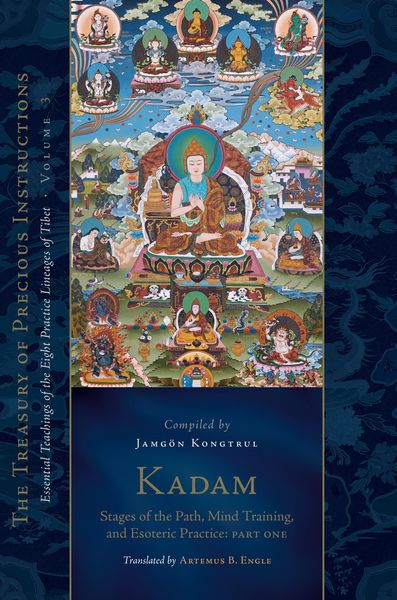
Kadam: Stages of the Path, Mind Training, and Esoteric Practice, Part One Essential Teachings of the Eight Practice Lineages of Tibet, Volume 3 (the Treasury of Precious Instructions)
Fr. 67.90
inkl. gesetzl. MwSt.,
Beschreibung
Produktdetails
Einband
Gebundene Ausgabe
Erscheinungsdatum
02.04.2024
Verlag
Snow Lion PublicationsSeitenzahl
1048
Maße (L/B/H)
23.3/16.4/6.9 cm
Gewicht
1568 g
Übersetzt von
Artemus B. Engle
Sprache
Englisch
ISBN
978-1-55939-505-2
The Treasury of Precious Instructions by Jamgön Kongtrul Lodrö Taye, one of Tibet’s greatest Buddhist masters, is a shining jewel of Tibetan literature, presenting essential teachings from the entire spectrum of practice lineages that existed in Tibet. In its eighteen volumes, Kongtrul brings together some of the most important texts on key topics of Buddhist thought and practice as well as authoring significant new sections of his own.
The Kadam lineage derives from the teachings and practices taught by the Indian master Atiśa and his Tibetan students. Atiśa spent twelve years in Tibet and left a scholarly and devotional lineage that would be significant to all traditions of Tibetan Buddhism, but particularly the Geluk, the tradition of the Dalai Lamas, which fashioned themselves as the New Kadam tradition.
Jamgön Kongtrul’s catalog to The Treasury of Precious Instructions classifies Kadam literature into five categories: treatise, instruction, esoteric practice, ancillary works, and associated works. The first two are the main topics covered in this volume: Lamrim, or Stages of the Path, and Lojong, or Mind Training. These two Kadam teachings continue to exert a significant influence on Tibetan Buddhism and therefore represent the legacy of the Kadam tradition.
The first centers around “The Lamp for the Path to Enlightenment,” written by the eleventh-century Indian master Atiśa who spent twelve years in Tibet, and this volume also includes stories of Atiśa’s life and travels. The second set of teachings consists of aphorisms known as the Seven-Point Mind Training, meant to be used as contemplative practices to develop compassion and transform the mind. These selections show not only the foundational texts of the Kadam tradition but also the widespread impact these teachings continued to have across traditions.
Kundinnen und Kunden meinen
Verfassen Sie die erste Bewertung zu diesem Artikel
Helfen Sie anderen Kund*innen durch Ihre Meinung