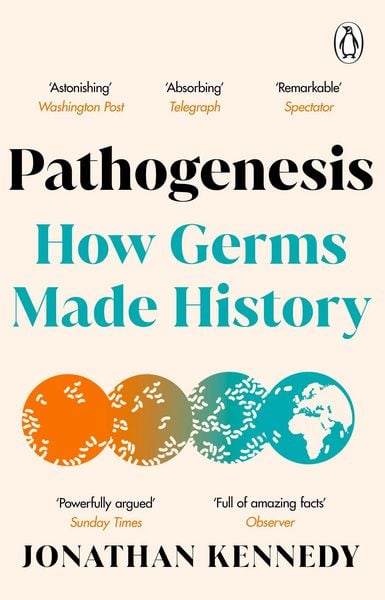
Pathogenesis How germs made history
-
- Taschenbuch ausgewählt
- eBook
-
Sprache:Englisch
-
Verlag:Transworld Publ. Ltd UK
Fr. 19.90
inkl. gesetzl. MwSt.,
-
Kostenlose Lieferung ab Fr. 30 Einkaufswert
Schweiz & Liechtenstein:
Versandkostenfrei ab Fr. 30.00
Versandkosten bis Fr. 30.00: Fr. 3.50Andere Lieferländer
Fr. 18.00 unabhängig vom Warenwert
Beschreibung
Produktdetails
Verkaufsrang
5246
Einband
Taschenbuch
Erscheinungsdatum
04.04.2024
Verlag
Transworld Publ. Ltd UKSeitenzahl
384
Maße (L/B/H)
19.5/12.9/3 cm
Gewicht
281 g
Sprache
Englisch
ISBN
978-1-80499-189-3
A BBC RADIO 4 BOOK OF THE WEEK
A TIMES SCIENCE BOOK OF THE YEAR
A SUNDAY TIMES SCIENCE BOOK OF THE YEAR
'Powerfully argued... Fascinating and pacy' Sunday Times, Book of the Week
'Superbly written... sure to please readers of Yuval Noah Harari or Rutger Bregman' The Times
'Full of amazing facts' Observer
'The book shines when it brings cutting-edge science to bear' Financial Times
'A dizzying range of material' The Economist
'A humbling story for humankind' Spectator
Challenges some of the greatest cliches about colonialism... A revelation' SATHNAM SANGHERA
'Thrilling and eye-opening' LEWIS DARTNELL
'Science and history at its best' MARK HONIGSBAUM
'Unpicks everything we thought we knew... Mind blowing' CAL FLYN
In this revelatory book, Dr Jonathan Kennedy argues that germs have shaped humanity at every stage, from the first success of Homo sapiens over the equally intelligent Neanderthals to the fall of Rome and the rise of Islam.
How did an Indonesian volcano help cause the Black Death, setting Europe on the road to capitalism? How could 168 men extract the largest ransom in history from an opposing army of eighty thousand? And why did the Industrial Revolution lead to the birth of the modern welfare state?
The latest science reveals that infectious diseases are not just something that happens to us, but a fundamental part of who we are. Indeed, the only reason humans don't lay eggs is that a virus long ago inserted itself into our DNA, and there are as many bacteria in your body as there are human cells. We have been thinking about the survival of the fittest all wrong: evolution is not simply about human strength and intelligence, but about how we live and thrive in a world dominated by microbes.
By exploring the startling intimacy of our relationship with infectious diseases, Kennedy shows how they have been responsible for some of the seismic revolutions of the past 50,000 years. Provocative and brimming with insight, Pathogenesis transforms our understanding of the human story, revealing how the crisis of a pandemic can offer vital opportunities for change.
Kundinnen und Kunden meinen
Verfassen Sie die erste Bewertung zu diesem Artikel
Helfen Sie anderen Kund*innen durch Ihre Meinung