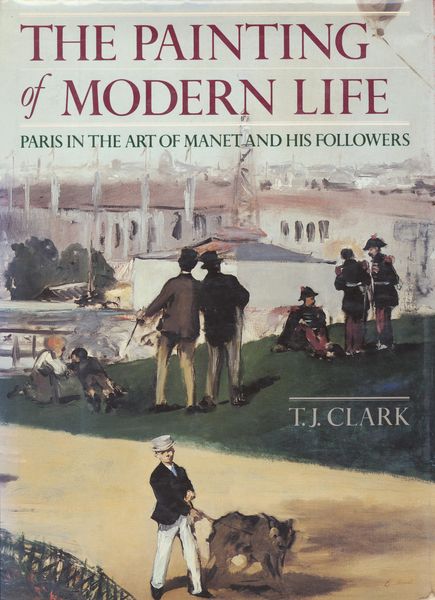
The Painting of Modern Life Paris in the Art of Manet and His Followers
-
- Taschenbuch
- eBook ausgewählt
-
Form:Einzelkauf Download
-
Sprache:Englisch
Fr. 15.90
inkl. gesetzl. MwSt.Beschreibung
Produktdetails
Format
ePUB 3
Kopierschutz
Ja
Family Sharing
Ja
Text-to-Speech
Ja
Erscheinungsdatum
28.06.2017
Verlag
Knopf Doubleday Publishing GroupSeitenzahl
338 (Printausgabe)
Dateigröße
201919 KB
Sprache
Englisch
EAN
9780525520511
From T.J. Clark comes this provocative study of the origins of modern art in the painting of Parisian life by Edouard Manet and his followers.
The Paris of the 1860s and 1870s was a brand-new city, recently adorned with boulevards, cafés, parks, Great Exhibitions, and suburban pleasure grounds-the birthplace of the habits of commerce and leisure that we ourselves know as "modern life." A new kind of culture quickly developed in this remade metropolis, sights and spectacles avidly appropriated by a new kind of "consumer": clerks and shopgirls, neither working class nor bourgeois, inventing their own social position in a system profoundly altered by their very existence. Emancipated and rootless, these men and women flocked to the bars and nightclubs of Paris, went boating on the Seine at Argenteuil, strolled the island of La Grande-Jatte-enacting a charade of community that was to be captured and scrutinized by Manet, Degas, and Seurat.
It is Clark's cogently argued (and profusely illustrated) thesis that modern art emerged from these painters' attempts to represent this new city and its inhabitants. Concentrating on three of Manet's greatest works and Seurat's masterpiece, Clark traces the appearance and development of the artists' favorite themes and subjects, and the technical innovations that they employed to depict a way of life which, under its liberated, pleasure-seeking surface, was often awkward and anxious.
Through their paintings, Manet and the Impressionists ask us, and force us to ask ourselves: Is the freedom offered by modernity a myth? Is modern life heroic or monotonous, glittering or tawdry, spectacular or dull? The Painting of Modern Life illuminates for us the ways, both forceful and subtle, in which Manet and his followers raised these questions and doubts, which are as valid for our time as for the age they portrayed.
The Paris of the 1860s and 1870s was a brand-new city, recently adorned with boulevards, cafés, parks, Great Exhibitions, and suburban pleasure grounds-the birthplace of the habits of commerce and leisure that we ourselves know as "modern life." A new kind of culture quickly developed in this remade metropolis, sights and spectacles avidly appropriated by a new kind of "consumer": clerks and shopgirls, neither working class nor bourgeois, inventing their own social position in a system profoundly altered by their very existence. Emancipated and rootless, these men and women flocked to the bars and nightclubs of Paris, went boating on the Seine at Argenteuil, strolled the island of La Grande-Jatte-enacting a charade of community that was to be captured and scrutinized by Manet, Degas, and Seurat.
It is Clark's cogently argued (and profusely illustrated) thesis that modern art emerged from these painters' attempts to represent this new city and its inhabitants. Concentrating on three of Manet's greatest works and Seurat's masterpiece, Clark traces the appearance and development of the artists' favorite themes and subjects, and the technical innovations that they employed to depict a way of life which, under its liberated, pleasure-seeking surface, was often awkward and anxious.
Through their paintings, Manet and the Impressionists ask us, and force us to ask ourselves: Is the freedom offered by modernity a myth? Is modern life heroic or monotonous, glittering or tawdry, spectacular or dull? The Painting of Modern Life illuminates for us the ways, both forceful and subtle, in which Manet and his followers raised these questions and doubts, which are as valid for our time as for the age they portrayed.
Noch keine Bewertungen vorhanden
Verfassen Sie die erste Bewertung zu diesem Artikel
Helfen Sie anderen Kundinnen und Kunden durch Ihre Meinung.