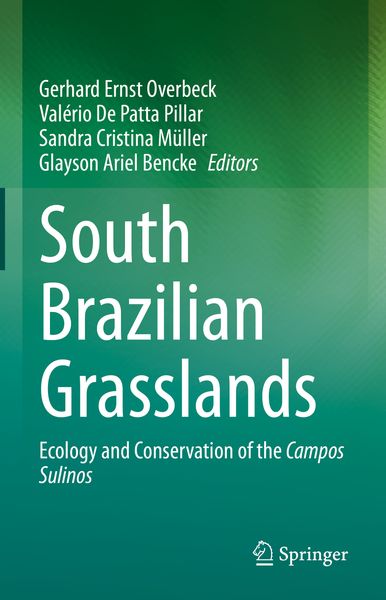
Produktbild: South Brazilian Grasslands

South Brazilian Grasslands Ecology and Conservation of the Campos Sulinos

Fr. 264.00

inkl. gesetzl. MwSt., Versandkostenfrei


Beschreibung

Produktdetails

Einband

Gebundene Ausgabe

Erscheinungsdatum

16.12.2023

Herausgeber

Gerhard Ernst Overbeck + weitere

Verlag

Springer

Seitenzahl

555

Maße (L/B/H)

24.1/16/3.6 cm

Gewicht

1010 g

Sprache

Englisch

ISBN

978-3-031-42579-0

Beschreibung

Portrait

Gerhard Overbeck holds a Degree in Landscape Planning (Dipl.-Ing.; 2002) and in Natural Sciences (Dr. rer. nat.; 2005) from the Technical University of Munich, Germany. Currently, he is Associate Professor at the Department of Botany at the Universidade Federal do Rio Grande do Sul, Porto Alegre, Brazil. His work focusses primarily on diversity and dynamics of vegetation, with a special interest on grasslands and on questions of conservation and restoration. He has professional experience in environmental planning and nature conservation and has acted as editor of several scientific journals in the areas of vegetation ecology and ecological restoration. He has participated in the America’s Assessment of the IPBES and is a contributor to the Brazilian Platform on Biodiversity and Ecosystem Services (BPBES). 

Valério Pillar is Professor Titular (Full Professor) of the Department of Ecology, Universidade Federal do Rio Grande do Sul, Research Fellow of CNPq (National Research Council, Brazil), and Chief Editor of Journal of Vegetation Science and Applied Vegetation Science. Graduated in Agronomy by Universidade Federal de Santa Maria (1981), MSc in Animal Science (Forage Plants) by Universidade Federal do Rio Grande do Sul (1988), and PhD in Plant Sciences (Quantitative Ecology) by University of Western Ontario (1992). Has research experience in community ecology and quantitative ecology, mainly on phenotypic and phylogenetic patterns in community assembly; biodiversity and ecosystem processes, grassland dynamics, management, conservation, fire and grazing disturbance; paleoecology and global change; methods of multivariate analysis, permutation tests and other resampling methods.  

Sandra Müller is Professor Titular at the Department of Ecology of the Universidade Federal do Rio Grande do Sul. She holds a degree in Biological Sciences from the Universidade de Passo Fundo (1996),a Master in Botany from the Universidade Federal do Rio Grande do Sul (1999) and a Doctor’s degree in Ecology from the Universidade Federal do Rio Grande do Sul (2005), conducted within a collaboration project with the Technische Universität München, Germany. Her research focuses on plant community ecology, especially on forest and grassland communities, disturbances and long-term dynamics, and functional ecology. Increasingly, she has been working with ecological restoration.

Glayson Bencke holds a Bachelor's Degree in Biology from the Universidade do Vale do Rio dos Sinos (1993) and a Master in Zoology from Universidade Estadual Paulista Júlio de Mesquita Filho (1998). He is staff researcher and curator of birds at the Rio Grande do Sul State Museum of Natural Sciences (now part of the State Department of Environment and Infrastructure), and has experience in the conservation of animals and animal communities, with a special focus on birds. Currently, he collaborates with the international initiative Alianza del Pastizal for the conservation of natural grasslands on private lands in the Campos Sulinos region and contributes with governmental and international organizations in the elaboration and execution of action plans for threatened bird species. 

Produktdetails

Einband

Gebundene Ausgabe

Erscheinungsdatum

16.12.2023

Herausgeber

Verlag

Springer

Seitenzahl

555

Maße (L/B/H)

24.1/16/3.6 cm

Gewicht

1010 g

Sprache

Englisch

ISBN

978-3-031-42579-0

Herstelleradresse

Springer-Verlag KG
Sachsenplatz 4-6
1201 Wien
AT

Email: ProductSafety@springernature.com

Kundinnen und Kunden meinen

0 Bewertungen

Informationen zu Bewertungen

Zur Abgabe einer Bewertung ist eine Anmeldung im Konto notwendig. Die Authentizität der Bewertungen wird von uns nicht überprüft. Wir behalten uns vor, Bewertungstexte, die unseren Richtlinien widersprechen, entsprechend zu kürzen oder zu löschen.

Die Bewertungen sind nach Format, Anzahl Sterne und Datum sortiert.

Verfassen Sie die erste Bewertung zu diesem Artikel

Helfen Sie anderen Kund*innen durch Ihre Meinung

Kundinnen und Kunden meinen

0 Bewertungen filtern

  • Produktbild: South Brazilian Grasslands
  • 1. Gondwana rocks & Holocene coastal plains: geology of the Campos Sulinos region and relation to current landscape features.- 2. A look into the past: fossils from the Campos Sulinos region.- 3. Past and current climate in the Campos Sulinos region and vegetation dynamics over time.- 4. A historical perspective on the biogeography of the Campos Sulinos region.- 5. Climatic and soil conditions across the Campos Sulinos region.- 6. Colonization and land use history in a marginal region.- 7. Grassland plant community composition and dynamics: disturbance as determinants of grassland diversity.- 8. Plant microevolutionary processes in the Campos Sulinos: why do they matter?.- 9. Campos Sulinos bird communities: effect of land use and management.- 10. Mammals in the Campos Sulinos: diversity and conservation status of grassland species.- 11. Amphibians and reptiles.- 12. Arthropods in the Campos Sulinos and their manifold ecosystem functions.- 13. Fish diversity in a grassland region.- 14.Soil organisms and their role for ecosystem processes.- 15. Wetlands in the Campos Sulinos: diversity, functions and threats.- 16. Soil carbon stocks and carbon storage in Campos Sulinos ecosystems.- 17. Trees and forests in a grassland region: biodiversity, conservation status and threats.- 18. Forest expansion over South Brazilian grasslands and mediating processes.- 19. Conservation of forest-grassland mosaics in southern Brazil.- 20. Future land use scenarios for southeastern South America.- 21. Invasive species: current status and future threats.- 22. Conservation policy in southern Brazil: instruments, implementation and future challenges.- 23. Restoration of grasslands and forest-grassland mosaics in the Campos Sulinos region.- 24. Sustainable development in the Campos Sulinos region.- 25. The future of Brazil's Campos Sulinos (Final Synthesis Chapter).