Beschreibung
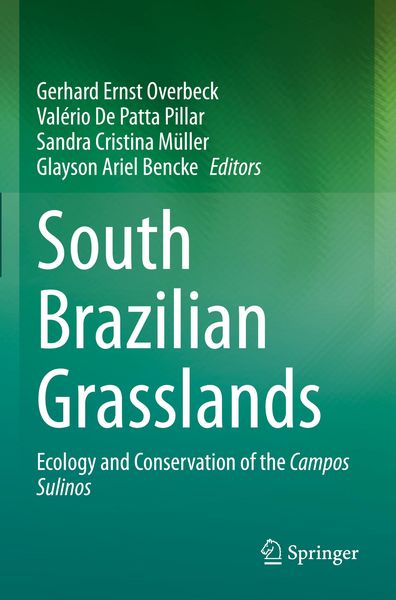
This volume explores the South Brazilian grasslands, a unique complex of ecosystems in Brazil. Despite high biodiversity and many important ecosystem services, their biodiversity and conservation are neglected, both nationally, and globally. This book provides a state-of-the-art synthesis of knowledge on the biodiversity and its drivers in South Brazilian grasslands and associated ecosystems. Further, the book discusses conservation challenges and options, as well as management strategies that help to maintain the region’s uniqueness. The chapters present information on biodiversity and ecological features of the region, and put this information into the context of historical and current human land uses, allowing for links to global discussions of conservation and sustainable development.
Altogether, the book contains 20 chapters organized in four sections. The book is directed at researchers, students and professionals working with biodiversity and sustainable development in southern Brazil, as well as to the international scientific and conservation community interested in grasslands and associated ecosystems, particularly in tropical and subtropical regions.
Portrait
Gerhard Overbeck
holds a Degree in Landscape Planning (Dipl.-Ing.; 2002) and in Natural Sciences (Dr. rer. nat.; 2005) from the Technical University of Munich, Germany. Currently, he is Associate Professor at the Department of Botany at the Universidade Federal do Rio Grande do Sul, Porto Alegre, Brazil. His work focusses primarily on diversity and dynamics of vegetation, with a special interest on grasslands and on questions of conservation and restoration. He has professional experience in environmental planning and nature conservation and has acted as editor of several scientific journals in the areas of vegetation ecology and ecological restoration. He has participated in the America’s Assessment of the IPBES and is a contributor to the Brazilian Platform on Biodiversity and Ecosystem Services (BPBES).
Valério Pillar
is Professor Titular (Full Professor) of the Department of Ecology, Universidade Federal do Rio Grande do Sul, Research Fellow of CNPq (National Research Council, Brazil), and Chief Editor of Journal of Vegetation Science and Applied Vegetation Science. Graduated in Agronomy by Universidade Federal de Santa Maria (1981), MSc in Animal Science (Forage Plants) by Universidade Federal do Rio Grande do Sul (1988), and PhD in Plant Sciences (Quantitative Ecology) by University of Western Ontario (1992). Has research experience in community ecology and quantitative ecology, mainly on phenotypic and phylogenetic patterns in community assembly; biodiversity and ecosystem processes, grassland dynamics, management, conservation, fire and grazing disturbance; paleoecology and global change; methods of multivariate analysis, permutation tests and other resampling methods.
Sandra Müller
is Professor Titular at the Department of Ecology of the Universidade Federal do Rio Grande do Sul. She holds a degree in Biological Sciences from the Universidade de Passo Fundo (1996),a Master in Botany from the Universidade Federal do Rio Grande do Sul (1999) and a Doctor’s degree in Ecology from the Universidade Federal do Rio Grande do Sul (2005), conducted within a collaboration project with the Technische Universität München, Germany. Her research focuses on plant community ecology, especially on forest and grassland communities, disturbances and long-term dynamics, and functional ecology. Increasingly, she has been working with ecological restoration.
Glayson Bencke
holds a Bachelor's Degree in Biology from the Universidade do Vale do Rio dos Sinos (1993) and a Master in Zoology from Universidade Estadual Paulista Júlio de Mesquita Filho (1998). He is staff researcher and curator of birds at the Rio Grande do Sul State Museum of Natural Sciences (now part of the State Department of Environment and Infrastructure), and has experience in the conservation of animals and animal communities, with a special focus on birds. Currently, he collaborates with the international initiative Alianza del Pastizal for the conservation of natural grasslands on private lands in the Campos Sulinos region and contributes with governmental and international organizations in the elaboration and execution of action plans for threatened bird species.