Band 25
Ubiquitous Radio Sensing Localization of Non-Cooperative Users
Aus der Reihe
Kommunikationstechnik
-
- Einzelkauf Download ausgewählt
-
Sprache:Englisch
Fr. 66.90
inkl. gesetzl. MwSt.Beschreibung
Produktdetails
Format
Kopierschutz
Nein
Family Sharing
Nein
Text-to-Speech
Nein
Erscheinungsdatum
25.07.2023
Verlag
Utzverlag GmbHSeitenzahl
168 (Printausgabe)
Dateigröße
13872 KB
Sprache
Englisch
EAN
9783831677450
Many applications in the emerging smart environments, such as smart cities and intelligent transportation, require an accurate situational awareness, i.e., information about presence and location of all users in the environment. A reliable situational awareness is based on robust communications and sensing techniques, as well as large-scale deployment. Therefore, an integration of sensing functionality is envisioned as a native capability of next generation wireless networks.
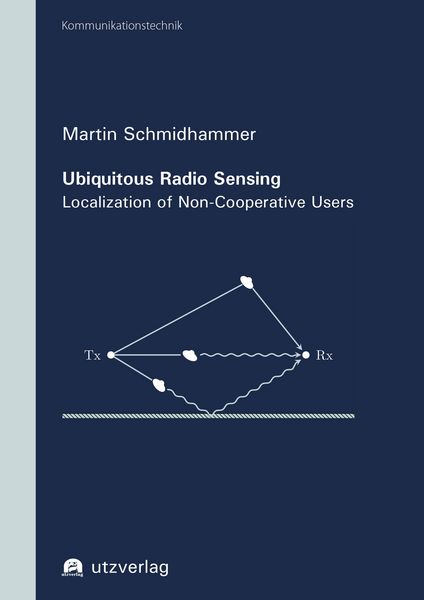
This work provides a novel radio sensing approach for the localization of non-cooperative users, referred to as multipath-enhanced device-free localization (MDFL). For localization, MDFL exploits user-induced variations in the received power of static signal components, i.e., line-of-sight and multipath components. Due to its low computational complexity, the proposed MDFL approach represents a suitable technique for the emerging perceptive wireless networks and can help to enable ubiquitous radio sensing.
This work provides a novel radio sensing approach for the localization of non-cooperative users, referred to as multipath-enhanced device-free localization (MDFL). For localization, MDFL exploits user-induced variations in the received power of static signal components, i.e., line-of-sight and multipath components. Due to its low computational complexity, the proposed MDFL approach represents a suitable technique for the emerging perceptive wireless networks and can help to enable ubiquitous radio sensing.
Noch keine Bewertungen vorhanden
Verfassen Sie die erste Bewertung zu diesem Artikel
Helfen Sie anderen Kundinnen und Kunden durch Ihre Meinung.