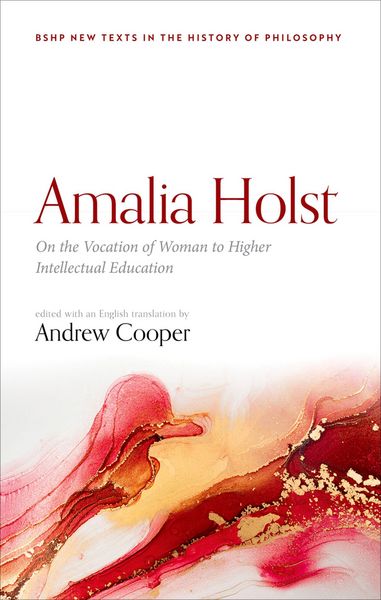
Amalia Holst: On the Vocation of Woman to Higher Intellectual Education
-
Form:Einzelkauf Download
-
Sprache:Englisch
-
eBook Format:PDF
- PDF Fr. 70.90 ausgewählt
- ePUB Fr. 70.90
Fr. 70.90
inkl. gesetzl. MwSt.Beschreibung
Produktdetails
Format
Kopierschutz
Ja
Family Sharing
Nein
Text-to-Speech
Nein
Erscheinungsdatum
16.02.2024
Herausgeber
Andrew CooperVerlag
Oxford University PressSeitenzahl
240 (Printausgabe)
Dateigröße
2995 KB
Sprache
Englisch
EAN
9780192660947
This edition offers the first English translation of Amalia Holst's daring book, On the Vocation of Woman to Higher Intellectual Education (1802). In one of the first works of German philosophy published under a woman's name, Holst presents a manifesto for women's education that centres on a basic provocation: as far as the mind is concerned, women are equal partakers in the project of Enlightenment and should thus have unfettered access to the sciences in general and to philosophy in particular. Holst's manifesto resonates with the work of several women writers across Europe, including Olympe de Gouges, Mary Wollstonecraft, and Germaine de StaÃ'l. Yet in contrast to the early works of feminism we celebrate today, her book had little success. Its reception confronts us with a darker side of the German Enlightenment that, until recently, has been neglected. Holst sought to unearth the gendered nature of the fundamental concepts of the Enlightenment--including vocation, education, and culture--which enabled men to establish the subordinate status of women by philosophical means. However, her argument was scorned by male reviewers, who denied the very possibility of a woman philosopher. With an introduction by Andrew Cooper, and translations of biographical material and early reviews, this edition provides students and scholars of German philosophy with a timely resource for developing a richer understanding of their field, and general readers with a powerful early feminist text that reveals the opportunities and difficulties facing women philosophers at the turn of the nineteenth century.
Noch keine Bewertungen vorhanden
Verfassen Sie die erste Bewertung zu diesem Artikel
Helfen Sie anderen Kundinnen und Kunden durch Ihre Meinung.