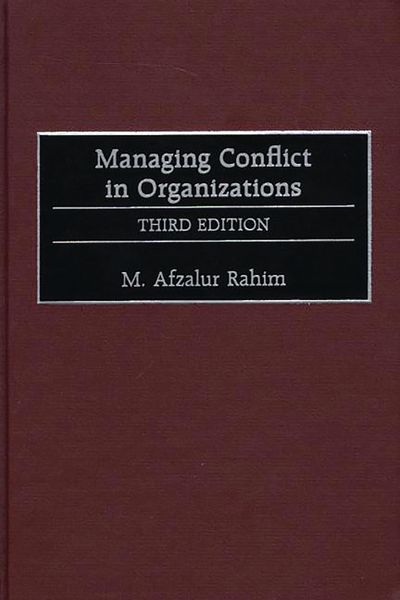
Managing Conflict in Organizations
-
- Hardcover
- Taschenbuch
- eBook ausgewählt
-
Form:Einzelkauf Download
-
Sprache:Englisch
-
eBook Format:PDF
- PDF Fr. 94.90 ausgewählt
- ePUB Fr. 61.90
-
Verlag:Bloomsbury eBooks US
Fr. 94.90
inkl. gesetzl. MwSt.Beschreibung
Produktdetails
Format
Kopierschutz
Ja
Family Sharing
Nein
Text-to-Speech
Nein
Altersempfehlung
ab 7 Jahr(e)
Erscheinungsdatum
30.12.2000
Verlag
Bloomsbury eBooks USSeitenzahl
312 (Printausgabe)
Auflage
3. Auflage
Sprache
Englisch
EAN
9780313000485
This revised and updated edition of Rahim's classic work on managing conflict in organizations presents new evidence that suggests, contrary to generally accepted views, that organizational conflict need not be minimized or avoided in all cases. Some conflicts are functional and others are dysfunctional. Substantive or task-related conflict is functional for nonroutine tasks, but affective conflicts are dysfunctional irrespective of the task conditions. Classifying conflicts as intrapersonal, interpersonal, intragroup, or intergroup, Rahim explains how to diagnose conflict, how to intervene effectively, and how to handle all the different types of conflict that typically arise in organizations.
Rahim's systematic approach to conflict management identifies five styles of handling conflict (integrating, obliging, dominating, avoiding, and compromising). These styles may be used in the course of an intervention, a technique that enables managers to minimize affective conflict while attaining and maintaining a moderate amount of substantive conflict at the individual, group, and intergroup levels. Rahim's book will be of interest to scholars, students, and practitioners in management, organizational psychology, human resources management, and communication.
Rahim's systematic approach to conflict management identifies five styles of handling conflict (integrating, obliging, dominating, avoiding, and compromising). These styles may be used in the course of an intervention, a technique that enables managers to minimize affective conflict while attaining and maintaining a moderate amount of substantive conflict at the individual, group, and intergroup levels. Rahim's book will be of interest to scholars, students, and practitioners in management, organizational psychology, human resources management, and communication.
Noch keine Bewertungen vorhanden
Verfassen Sie die erste Bewertung zu diesem Artikel
Helfen Sie anderen Kundinnen und Kunden durch Ihre Meinung.