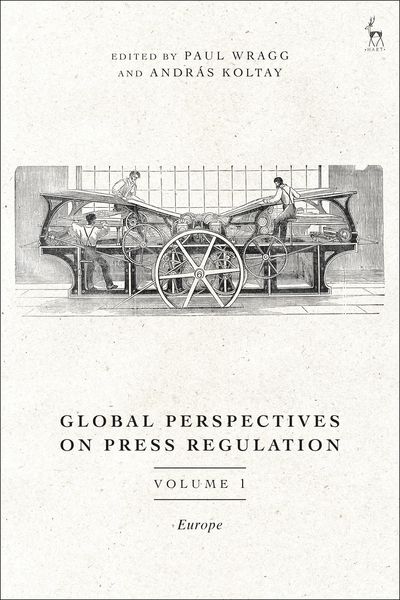
Global Perspectives on Press Regulation, Volume 1 Europe
-
- Hardcover
- Taschenbuch
- eBook ausgewählt
-
Form:Einzelkauf Download
-
Sprache:Englisch
-
eBook Format:ePUB
- PDF Fr. 56.90
- ePUB Fr. 56.90 ausgewählt
Fr. 56.90
inkl. gesetzl. MwSt.Beschreibung
Produktdetails
Format
ePUB
Kopierschutz
Ja
Family Sharing
Nein
Text-to-Speech
Ja
Erscheinungsdatum
21.09.2023
Herausgeber
Paul Wragg + weitereVerlag
Bloomsbury eBooks UKSeitenzahl
416 (Printausgabe)
Auflage
1. Auflage
Sprache
Englisch
EAN
9781509950355
In this ground-breaking two-volume set, world-leading experts produce a rich, authoritative depiction of the world's press, its freedom, and its limits.
We want press freedom but we also want freedom from the press. A powerful press may expose a corrupt government or aid it. It may champion citizens or unfairly attack them. A vulnerable press may lack supporters and succumb to conformity. It may resist, and overcome tyranny. According to common belief, press freedom involves social responsibilities to equip public debate and render government transparent. Is this attitude valid given that the press is usually a private, commercial actor?
Globally, the health, authority, and viability of the press varies dramatically. These patterns do not conform to traditional divisions between North and South, East and West. Instead, they are much more complex. How do we measure successful press regulation? What concessions can the state and/or society demand from the press? What constitutes the irreducible core of press freedom?
The contributions in Volume 1 look at key jurisdictions in Europe; whereas Volume 2 goes beyond Europe to analyse the situation in key jurisdictions in Asia, Africa, the Americas and Oceania. Each volume can be used independently or as part of the complete set.
This work will be incredibly valuable to policymakers and academics who seek to capture the global picture for the purposes of effecting change.
We want press freedom but we also want freedom from the press. A powerful press may expose a corrupt government or aid it. It may champion citizens or unfairly attack them. A vulnerable press may lack supporters and succumb to conformity. It may resist, and overcome tyranny. According to common belief, press freedom involves social responsibilities to equip public debate and render government transparent. Is this attitude valid given that the press is usually a private, commercial actor?
Globally, the health, authority, and viability of the press varies dramatically. These patterns do not conform to traditional divisions between North and South, East and West. Instead, they are much more complex. How do we measure successful press regulation? What concessions can the state and/or society demand from the press? What constitutes the irreducible core of press freedom?
The contributions in Volume 1 look at key jurisdictions in Europe; whereas Volume 2 goes beyond Europe to analyse the situation in key jurisdictions in Asia, Africa, the Americas and Oceania. Each volume can be used independently or as part of the complete set.
This work will be incredibly valuable to policymakers and academics who seek to capture the global picture for the purposes of effecting change.
Noch keine Bewertungen vorhanden
Verfassen Sie die erste Bewertung zu diesem Artikel
Helfen Sie anderen Kundinnen und Kunden durch Ihre Meinung.