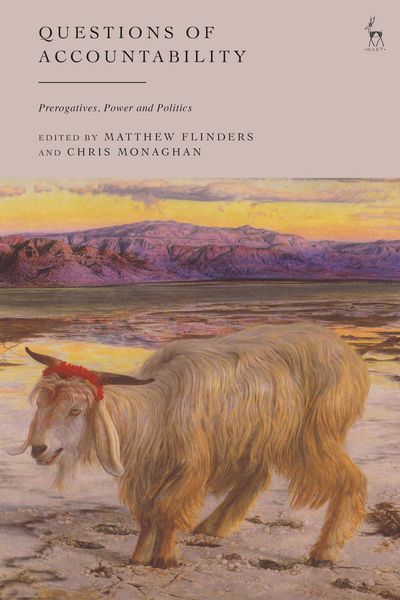
Questions of Accountability Prerogatives, Power and Politics
-
- Hardcover
- Taschenbuch
- eBook ausgewählt
-
Form:Einzelkauf Download
-
Sprache:Englisch
-
eBook Format:ePUB
- PDF Fr. 54.90
- ePUB Fr. 54.90 ausgewählt
Fr. 54.90
inkl. gesetzl. MwSt.Beschreibung
Produktdetails
Format
ePUB
Kopierschutz
Ja
Family Sharing
Nein
Text-to-Speech
Ja
Erscheinungsdatum
21.09.2023
Herausgeber
Matthew Flinders + weitereVerlag
Bloomsbury eBooks UKSeitenzahl
368 (Printausgabe)
Auflage
1. Auflage
Sprache
Englisch
EAN
9781509964239
This book explores accountability from a range of perspectives, crossing traditional disciplinary, thematic, and professional boundaries. It asks fresh questions about accountability and its place and importance in democratic societies.
Accountability matters. It matters because it connects the governors with the governed, and for this reason it is a hallmark of democratic governance. And yet, amidst a backdrop of concerns about democratic back-sliding, the rise of populism, the role of algorithmic governance, moral barbarism, and post-truth politics - to mention just a few issues - a number of potentially far-reaching questions of accountability have been asked. It is for exactly this reason that this book explores the concept of accountability from a range of perspectives, crossing traditional disciplinary, thematic, and professional boundaries. It asks fresh questions about accountability and its place and importance in democratic societies.
The book considers the questions raised by the shifting architecture of accountability. Whilst some scholars suggest that accountability processes have never been so effective -trumpeting the rise of monitory democracy with its dense array of watchdogs, sleaze-busters, auditors, legislative committees, statutory supports, and investigative mechanisms - others express concern about the risk of 'overloads', 'gaps', and 'traps'. This has led to a focus on fuzzy accountability and diagonal accountability, pointing to increasing conceptual confusion.
Bringing together world-leading scholars and former politicians and public servants, the book cuts through this confusion and provides the reader with the answers to the most debated issues, including rarely discussed 'pathologies of accountability', post-human governance, and a novel focus on balance and proportionality.
Accountability matters. It matters because it connects the governors with the governed, and for this reason it is a hallmark of democratic governance. And yet, amidst a backdrop of concerns about democratic back-sliding, the rise of populism, the role of algorithmic governance, moral barbarism, and post-truth politics - to mention just a few issues - a number of potentially far-reaching questions of accountability have been asked. It is for exactly this reason that this book explores the concept of accountability from a range of perspectives, crossing traditional disciplinary, thematic, and professional boundaries. It asks fresh questions about accountability and its place and importance in democratic societies.
The book considers the questions raised by the shifting architecture of accountability. Whilst some scholars suggest that accountability processes have never been so effective -trumpeting the rise of monitory democracy with its dense array of watchdogs, sleaze-busters, auditors, legislative committees, statutory supports, and investigative mechanisms - others express concern about the risk of 'overloads', 'gaps', and 'traps'. This has led to a focus on fuzzy accountability and diagonal accountability, pointing to increasing conceptual confusion.
Bringing together world-leading scholars and former politicians and public servants, the book cuts through this confusion and provides the reader with the answers to the most debated issues, including rarely discussed 'pathologies of accountability', post-human governance, and a novel focus on balance and proportionality.
Kundinnen und Kunden meinen
Verfassen Sie die erste Bewertung zu diesem Artikel
Helfen Sie anderen Kund*innen durch Ihre Meinung