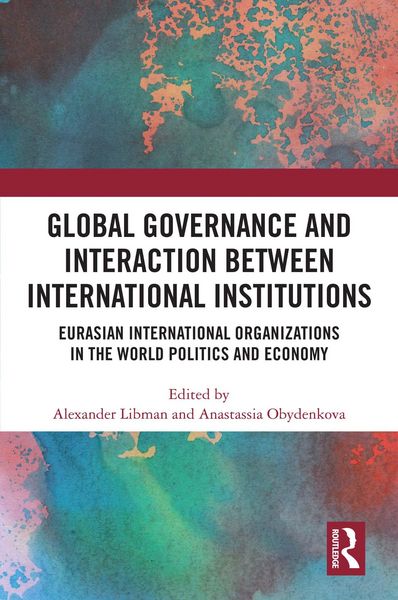
Global Governance and Interaction between International Institutions Eurasian International Organizations in the World Politics and Economy
-
- Hardcover
- Taschenbuch
- eBook ausgewählt
-
Form:Einzelkauf Download
-
Sprache:Englisch
-
eBook Format:ePUB 3
- ePUB 3 Fr. 65.90 ausgewählt
- PDF Fr. 65.90
Fr. 65.90
inkl. gesetzl. MwSt.Beschreibung
Produktdetails
Format
ePUB 3
Kopierschutz
Ja
Family Sharing
Nein
Text-to-Speech
Ja
Erscheinungsdatum
26.09.2023
Herausgeber
Alexander Libman + weitereVerlag
Taylor & Francis eBooksSeitenzahl
246 (Printausgabe)
Auflage
1. Auflage
Sprache
Englisch
EAN
9781000964196
This book builds on theory of authoritarian regionalism and is the first attempt to analyse the interaction of authoritarian regional organizations in Eurasia with their global and regional counterparts (NATO, EU, WTO, IMF etc.). It analyses three decades of the development of post-Soviet regional organizations prior to the tectonic geopolitical and security changes of 2022.
Eurasian regional organizations created by Russia have been frequently perceived as attempts to establish 'alternatives' to the global governance institutions and to compete with other regional organizations like, for example, the European Union (EU). They are seen as a pronounced example of 'authoritarian regionalism', i.e., regional organizations established by non-democracies. The way they interact with global and regional institutions has, however, remained understudied. This book aims to close this gap. It places Eurasia within a global context and considers similar trends world-wide as well as outlines the agenda for future studies of global versus regional governance. The book sheds light on long-term strategies of Russia in Eurasia, in global economy and in world politics, and on the interaction between Russia and other post-Soviet states.
With an extended introduction and conclusion, this book is an insightful resource for scholars; advanced students; and researchers of politics, international relations, and Eurasian area-studies. The chapters in this book were originally published as a special issue of Post-Communist Economies.
Noch keine Bewertungen vorhanden
Verfassen Sie die erste Bewertung zu diesem Artikel
Helfen Sie anderen Kundinnen und Kunden durch Ihre Meinung.