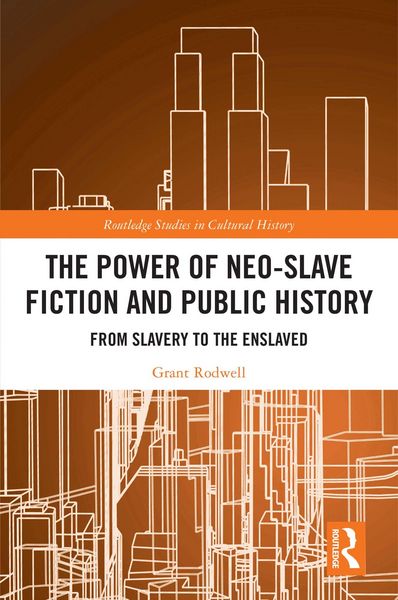
The Power of Neo-Slave Fiction and Public History From Slavery to the Enslaved
-
- Hardcover
- Taschenbuch
- eBook ausgewählt
-
Form:Einzelkauf Download
-
Sprache:Englisch
-
eBook Format:PDF
- PDF Fr. 64.90 ausgewählt
- ePUB Fr. 64.90
Fr. 64.90
inkl. gesetzl. MwSt.Beschreibung
Produktdetails
Format
Kopierschutz
Ja
Family Sharing
Nein
Text-to-Speech
Nein
Erscheinungsdatum
13.10.2023
Verlag
Taylor & Francis eBooksSeitenzahl
238 (Printausgabe)
Auflage
1. Auflage
Sprache
Englisch
EAN
9781000987133
Professional historians, schools, colleges and universities are not alone in shaping higher-order understanding of history. The central thesis of this book is the belief historical fiction in text and film shape attitudes towards an understanding of history as it moves the focus from slavery to the enslaved-from the institution to the personal, families and feminist accounts.
In a broader sense, this contributes to a public history. In part, using the quickly growing corpus of neo-slave counterfactual narratives, this book examines the notion of the emerging slavery public history, and the extent to which this is defined by literature, film and other forms of artistic expression, rather than non-fiction-popular or scholarly-and education in history in the school systems. Inter alia, this book looks to the validity of historical fiction in print or in film as a way of understanding history. A focal point of this book is the hypothesis that neo-slave narratives-supported by selective triangulated readings and viewings of scholarly works and non-fiction-have assisted greatly in re-shaping the historiography of antebellum slavery, and scholarly historians followed in the wake of these developments. Essentially, this has meant a re-shaping of the historiography with a focus from slavery to that of the enslaved. Moreover, it has opened new vistas for a public history, devoid of top-down authoritative scholarship.
An important and provocative read for students and scholars interested in understanding the history of slavery, its harrowing effects and how it was culturally defined.
Noch keine Bewertungen vorhanden
Verfassen Sie die erste Bewertung zu diesem Artikel
Helfen Sie anderen Kundinnen und Kunden durch Ihre Meinung.