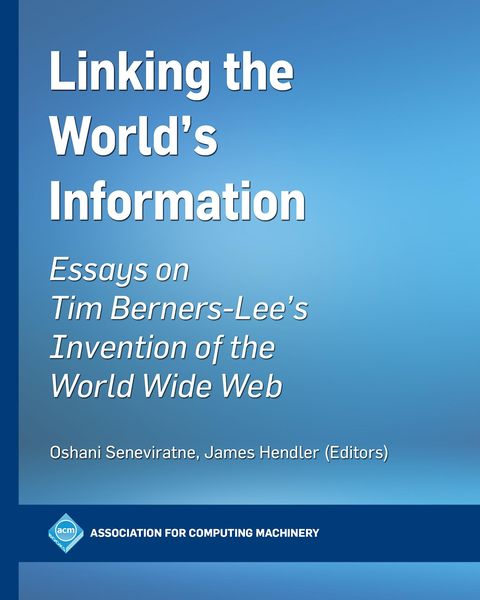
Linking the World's Information Essays on Tim Berners-Lee's Invention of the World Wide Web
-
- Einzelkauf Download ausgewählt
-
Sprache:Englisch
Fr. 35.90
inkl. gesetzl. MwSt.Beschreibung
Produktdetails
Format
ePUB
Kopierschutz
Nein
Family Sharing
Nein
Text-to-Speech
Ja
Erscheinungsdatum
13.09.2023
Herausgeber
Oshani Seneviratne + weitereVerlag
Association for Computing MachinerySeitenzahl
288 (Printausgabe)
Auflage
1. Auflage
Sprache
Englisch
EAN
9798400707933
When Sir Tim Berners-Lee first proposed the foundations of the World Wide Web at CERN in 1989, his manager called it "vague, but exciting." How things have changed since then! Twenty-six years later, Berners-Lee won the ACM Turing Award "for inventing the World Wide Web, the first Web browser, and the fundamental protocols and algorithms allowing the Web to scale." This book is a compilation of articles on the original ideas of a true visionary and the subsequent research and development work he has led, helping to realize the Web's full potential. It is intended for readers interested in the Web's original technical development, how it has changed over time, and the social impacts of the Web as steered by Berners-Lee since the very beginning.
The book covers Berners-Lee's development of the key protocols, naming schemes, and markup languages that led to his "world wide web" program and ultimately to the Web as we know it today. His early efforts were refined as Web technology spread around the world, and he was further guided by the work of the World Wide Web Consortium, which he founded and still directs. He was instrumental in the conceptualization and realization of the Semantic Web, a field that is gaining momentum in the age of big data and knowledge graphs; was a driving force for the field of Web Science, a new and growing research area dedicated to the study of both the engineering and the impacts of the Web; and he continues to innovate through his research work at MIT on open and decentralized information. Berners-Lee is also known for his contributions to keeping the Web open and ubiquitous via his work with the World Wide Web Foundation, the UK's Open Data Institute and his recent call for a crowdsourced magna carta for the Web. This book will help the reader to understand how Sir Tim's invention of the World Wide Web has revolutionized not just Computer Science, but global society itself.
Noch keine Bewertungen vorhanden
Verfassen Sie die erste Bewertung zu diesem Artikel
Helfen Sie anderen Kundinnen und Kunden durch Ihre Meinung.