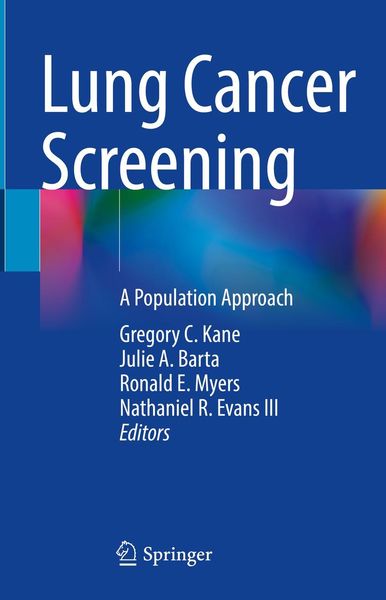
Lung Cancer Screening A Population Approach
-
- Hardcover
- Taschenbuch
- eBook ausgewählt
-
Form:Einzelkauf Download
-
Sprache:Englisch
Fr. 125.90
inkl. gesetzl. MwSt.Beschreibung
Produktdetails
Format
Kopierschutz
Nein
Family Sharing
Nein
Text-to-Speech
Nein
Erscheinungsdatum
24.08.2023
Herausgeber
Gregory C. Kane + weitereVerlag
Springer Nature SwitzerlandSeitenzahl
390 (Printausgabe)
Dateigröße
13161 KB
Sprache
Englisch
EAN
9783031335969
This book is a comprehensive guide to lung cancer screening for clinicians, healthcare systems, community leaders, and public health officials with the hope of creating a more equitable landscape in both lung cancer screening and lung cancer-related outcomes, at local, state, and national levels. Authors take a new approach to primary and secondary lung cancer prevention that is in the early stages of adoption in the United States. The last decade ushered in recognition of screening as an effective intervention, but unfortunately, despite the wide acceptance of the importance of this new screening modality, nationally, not more than 5% of eligible subjects have undergone screening to date in the United States, although in some states uptake has reached as high as 16%. As is common with any new preventive cancer screening, racial and socioeconomic disparities emerge in utilization, stage at diagnosis, and mortality. Over time, these disparities decline, but consequential differences endure. Therefore, it is critical to establish equitable screening practices.
The true measure of the effectiveness of any lung cancer screening program needs to be viewed through the lens of its impact on populations, including those most affected by the morbidity and mortality of smoking-related illness and lung cancer. As such, this book emphasizes a number of important public health topics, including community outreach to vulnerable populations, social justice issues, addressing stigma and fatalism in the general community, and the use of geocoding to assess a program's impact at a population level. This book weaves traditional topics related to lung cancer screening, such as promoting initial and repeat screening, interpreting Lung RADs, and managing the follow-up of findings, into the population perspective in order to present a unified, comprehensive approach to the subject. Further, it serves as a guide that health systems, health care professionals, community leaders, and other stakeholders can use to achieve the promise of lung cancer screening.
Noch keine Bewertungen vorhanden
Verfassen Sie die erste Bewertung zu diesem Artikel
Helfen Sie anderen Kundinnen und Kunden durch Ihre Meinung.
Weitere Artikel finden Sie in
- eBooks >
- Fachbücher >
- Medizin