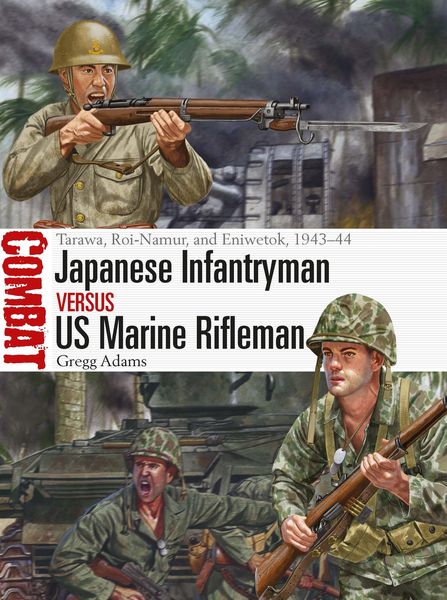
Japanese Infantryman vs US Marine Rifleman Tarawa, Roi-Namur, and Eniwetok, 1943-44
-
- Taschenbuch
- eBook ausgewählt
-
Form:Einzelkauf Download
-
Sprache:Englisch
-
eBook Format:ePUB
- PDF Fr. 17.90
- ePUB Fr. 17.90 ausgewählt
Fr. 17.90
inkl. gesetzl. MwSt.Beschreibung
Produktdetails
Format
ePUB
Kopierschutz
Ja
Family Sharing
Nein
Text-to-Speech
Ja
Erscheinungsdatum
26.10.2023
Illustriert von
Johnny Shumate
Verlag
Bloomsbury eBooks UKSeitenzahl
80 (Printausgabe)
Auflage
1. Auflage
Sprache
Englisch
EAN
9781472857897
Featuring evocative artwork plates and carefully selected photographs, this book assesses the US Marines and Japanese troops who contested the islands of Tarawa, Roi-Namur, and Eniwetok during 1943-44.
On November 20, 1943, amphibious vehicles carrying Marines of the 2d Marine Division reached the shores of Betio Island in the Tarawa Atoll, defended by a determined Japanese garrison that would fight to the last man. This began a test by combat of over two decades of US studies, analyses, and planning for capturing and defending naval bases in Micronesia. The Tarawa assault was followed in February 1944 by the rapid capture of the Kwajalein and Eniwetok atolls in the Marshall Islands.
In these battles US Marines fought a mix of Imperial Japanese Navy and Imperial Japanese Army ground units. All but a handful of the defenders, whether they were organized ground combat troops or infantry improvised from aviators and service troops, were determined to die for the Emperor while killing as many of the enemy as possible. In this study, Gregg Adams shows how the US Marine Corps and US Navy drew upon these pivotal actions to improve their tactics, organization, and equipment for the next round of amphibious operations. He also explains how their Japanese opponents - realizing that isolated island garrisons were doomed to destruction or isolation if the Imperial Japanese Navy could not defeat the US Navy at sea - moved from seeking to repel an invasion to one inflicting maximum American casualties through prolonged defensive fighting.
On November 20, 1943, amphibious vehicles carrying Marines of the 2d Marine Division reached the shores of Betio Island in the Tarawa Atoll, defended by a determined Japanese garrison that would fight to the last man. This began a test by combat of over two decades of US studies, analyses, and planning for capturing and defending naval bases in Micronesia. The Tarawa assault was followed in February 1944 by the rapid capture of the Kwajalein and Eniwetok atolls in the Marshall Islands.
In these battles US Marines fought a mix of Imperial Japanese Navy and Imperial Japanese Army ground units. All but a handful of the defenders, whether they were organized ground combat troops or infantry improvised from aviators and service troops, were determined to die for the Emperor while killing as many of the enemy as possible. In this study, Gregg Adams shows how the US Marine Corps and US Navy drew upon these pivotal actions to improve their tactics, organization, and equipment for the next round of amphibious operations. He also explains how their Japanese opponents - realizing that isolated island garrisons were doomed to destruction or isolation if the Imperial Japanese Navy could not defeat the US Navy at sea - moved from seeking to repel an invasion to one inflicting maximum American casualties through prolonged defensive fighting.
Noch keine Bewertungen vorhanden
Verfassen Sie die erste Bewertung zu diesem Artikel
Helfen Sie anderen Kundinnen und Kunden durch Ihre Meinung.