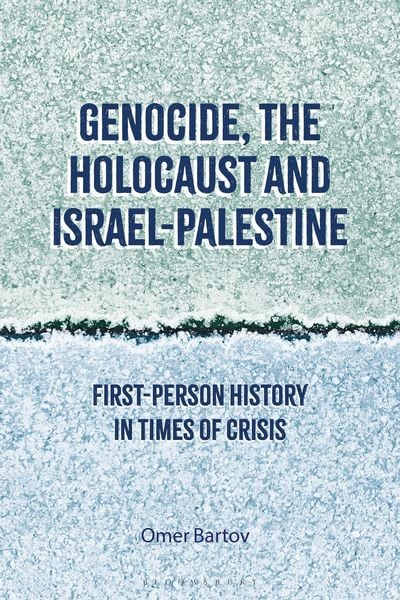
Genocide, the Holocaust and Israel-Palestine First-Person History in Times of Crisis
-
- Hardcover
- Taschenbuch
- eBook ausgewählt
-
Form:Einzelkauf Download
-
Sprache:Englisch
- Deutsch Fr. 37.00
- Englisch Fr. 32.90 ausgewählt
-
eBook Format:ePUB
- PDF Fr. 32.90
- ePUB Fr. 32.90 ausgewählt
Fr. 32.90
inkl. gesetzl. MwSt.Beschreibung
Produktdetails
Format
ePUB
Kopierschutz
Ja
Family Sharing
Nein
Text-to-Speech
Ja
Erscheinungsdatum
13.07.2023
Verlag
Bloomsbury eBooks UKSeitenzahl
264 (Printausgabe)
Auflage
1. Auflage
Sprache
Englisch
EAN
9781350332348
A 2024 Choice Outstanding Academic Title
This book discusses some of the most urgent current debates over the study, commemoration, and politicization of the Holocaust through key critical perspectives. Omer Bartov adeptly assesses the tensions between Holocaust and genocide studies, which have repeatedly both enriched and clashed with each other, whilst convincingly arguing for the importance of local history and individual testimony in grasping the nature of mass murder. He goes on to critically examine how legal discourse has served to both uncover and deny individual and national complicity. Genocide, the Holocaust and Israel-Palestine outlines how first-person histories provide a better understanding of events otherwise perceived as inexplicable and, lastly, draws on the author's own personal trajectory to consider links between the fate of Jews in World War II and the plight of Palestinians during and in the aftermath of the establishment of the state of Israel.
Bartov demonstrates that these five perspectives, rarely if ever previously discussed in a single book, are inextricably linked, and shed much light on each other. Thus the Holocaust and other genocides must be seen as related catastrophes in the modern era; understanding such vast human tragedies necessitates scrutinizing them on the local and personal scale; this in turn calls for historical empathy, accomplished via personal-biographical introspection; and true, open-minded, and rigorous introspection, without which historical understanding tends toward obfuscation, brings to light uncomfortable yet clarifying connections, such as that between the Holocaust and the Nakba, the mass flight and expulsion of the Palestinians in 1948.
This book discusses some of the most urgent current debates over the study, commemoration, and politicization of the Holocaust through key critical perspectives. Omer Bartov adeptly assesses the tensions between Holocaust and genocide studies, which have repeatedly both enriched and clashed with each other, whilst convincingly arguing for the importance of local history and individual testimony in grasping the nature of mass murder. He goes on to critically examine how legal discourse has served to both uncover and deny individual and national complicity. Genocide, the Holocaust and Israel-Palestine outlines how first-person histories provide a better understanding of events otherwise perceived as inexplicable and, lastly, draws on the author's own personal trajectory to consider links between the fate of Jews in World War II and the plight of Palestinians during and in the aftermath of the establishment of the state of Israel.
Bartov demonstrates that these five perspectives, rarely if ever previously discussed in a single book, are inextricably linked, and shed much light on each other. Thus the Holocaust and other genocides must be seen as related catastrophes in the modern era; understanding such vast human tragedies necessitates scrutinizing them on the local and personal scale; this in turn calls for historical empathy, accomplished via personal-biographical introspection; and true, open-minded, and rigorous introspection, without which historical understanding tends toward obfuscation, brings to light uncomfortable yet clarifying connections, such as that between the Holocaust and the Nakba, the mass flight and expulsion of the Palestinians in 1948.
Noch keine Bewertungen vorhanden
Verfassen Sie die erste Bewertung zu diesem Artikel
Helfen Sie anderen Kundinnen und Kunden durch Ihre Meinung.