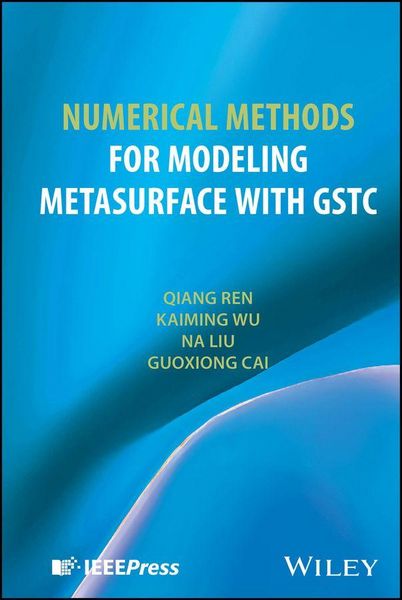
Numerical Methods for Modeling Metasurface with Gstc
-
- Englisch ausgewählt
Fr. 193.00
inkl. gesetzl. MwSt.,
Beschreibung
Produktdetails
Einband
Gebundene Ausgabe
Erscheinungsdatum
22.09.2026
Verlag
John Wiley & SonsSeitenzahl
256
Maße (L/B/H)
23.3/16/1.9 cm
Gewicht
490 g
Sprache
Englisch
ISBN
978-1-394-24429-4
Introduction to current modeling methods for electromagnetic metasurfaces using the generalized sheet transition condition
Numerical Methods for Modeling Metasurface with GSTC provides a systemic and deep monograph of numerical modeling approaches for metasurfaces and thoroughly explores various numerical methods, encompassing not only those in the frequency domain, but also those in the time domain that incorporate generalized sheet transition conditions (GSTCs). It then introduces the mainstream full-wave computational electromagnetic method, including finite-difference frequency-domain method (FDFD), method of moments (MoM), finite element method (FEM), spectral element method (SEM), finite-difference time-domain method (FDTD), and discontinue Galerkin time-domain method (DGTD), and the incorporation of GSTC with these numerical methods. Well-designed examples show that the GSTC equivalence is a quick and accurate tool for metasurface analysis.
Written by a team of highly qualified authors, Numerical Methods for Modeling Metasurface with GSTC also includes information on:
- The basics of metasurfaces, the GSTC technique, and computational electromagnetics methods
- Metasurfaces modeling, covering media homogenization techniques, GSTC theory, and the susceptibility synthesis method
- Methods to simulate steady or transient responses of both planar and curved metasurfaces
Numerical Methods for Modeling Metasurface with GSTC is an essential up-to-date reference on the subject for academic researchers and engineers in electromagnetics, optics, and applied physics and graduate and senior undergraduate students in related programs of study.
Noch keine Bewertungen vorhanden
Verfassen Sie die erste Bewertung zu diesem Artikel
Helfen Sie anderen Kundinnen und Kunden durch Ihre Meinung.