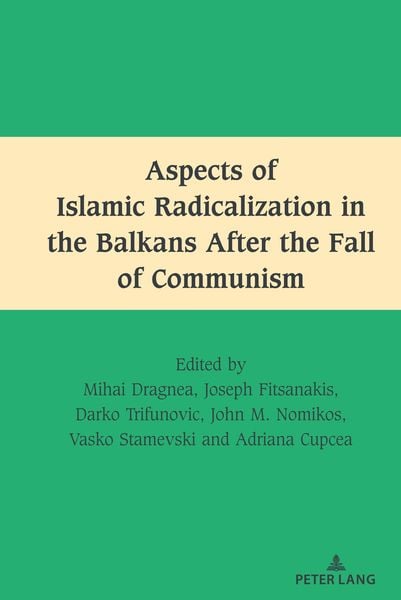
Aspects of Islamic Radicalization in the Balkans After the Fall of Communism
-
Form:Einzelkauf Download
-
Sprache:Englisch
-
eBook Format:ePUB
- PDF Fr. 110.90
- ePUB Fr. 99.90 ausgewählt
Fr. 99.90
inkl. gesetzl. MwSt.Beschreibung
Produktdetails
Format
ePUB
Kopierschutz
Ja
Family Sharing
Ja
Text-to-Speech
Ja
Erscheinungsdatum
31.08.2023
Herausgeber
Dragnea Mihai Dragnea + weitereVerlag
Peter Lang Inc., International Academic PublishersSeitenzahl
(Printausgabe)
Dateigröße
2856 KB
Sprache
Englisch
EAN
9781433198700
This book explores the channels through which Islamic fundamentalism has spread among Muslim populations in the Balkans since the fall of communism. The authors collectively examine political and religious ties between Balkan Muslims and various private organizations and state institutions in Muslim states, with a particular focus on the reception of Salafism and its Saudi version, Wahhabism. In that context, they debate the extent to which war crimes committed by Muslims during the Yugoslav Wars were motivated by Salafism, rather than being a result of domestic ethno-national conflicts. Finally, the book also addresses the ideological climate that has generated volunteers for Islamic State (Daesh) in recent years.
Cumulatively these essays emphasize the risks to national security in the Western Balkans represented by the return of Islamic State fighters and the spread of so-called jihadist-Salafism within Muslim communities. The volume is intended to help the reader understand the Balkan states' foreign policy as a response towards the Muslim world in the context of the global war against terrorism. It is the outcome of a research project of the Balkan History Association.
"This volume shows that Muslim communities in the Western Balkans face intense propaganda from radical Islam and the incitement of hatred and interreligious divisions, aiming to indoctrinate moderate and tolerant Balkan Muslims. Kosovar youth, for instance, are exposed to a radical ideology which, under the influence of imams trained in fundamentalist madrassas in the Middle East, aims to create a new kind of Muslim, one who is ignorant of the past, of national identity and the values of democracy, and who is concerned only with 'Islamic' values propagated through Salafism."
-Kolë Krasniqi, University "Haxhi Zeka" in Peja, Kosovo
"Although Islam has historically been a socio-cultural pillar of Southeast European societies, the recent turmoil and failed revolutions across the Muslim world have influenced sections of Muslim communities in the region. This excellent collected volume is a much-needed attempt to trace the subtle workings of re-Islamisation and changes in traditional Muslim identities under the influence of foreign forms of Islam. All chapters show remarkable scholarly achievement and the fruitfulness of pursuing interdisciplinary perspectives on the development of Balkan Muslims communities since 1989."
-Francesco Trupia, Nicolaus Copernicus University, Poland
Noch keine Bewertungen vorhanden
Verfassen Sie die erste Bewertung zu diesem Artikel
Helfen Sie anderen Kundinnen und Kunden durch Ihre Meinung.