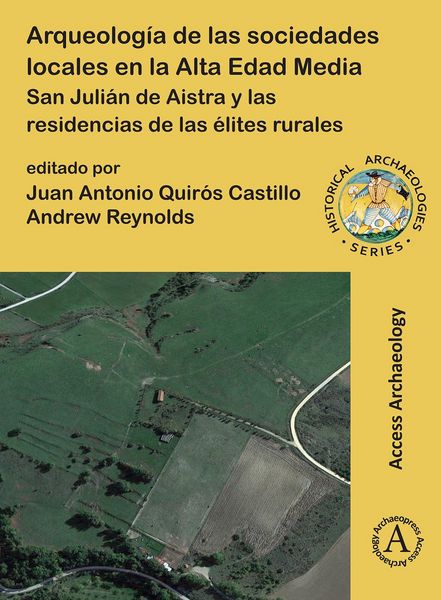
Arqueologia de las sociedades locales en la Alta Edad Media
Aus der Reihe
Historical Archaeologies Series
-
- Taschenbuch
- eBook ausgewählt
-
Form:Einzelkauf Download
-
Sprache:Spanisch
Fr. 2.90
inkl. gesetzl. MwSt.Beschreibung
Produktdetails
Format
Kopierschutz
Ja
Family Sharing
Ja
Text-to-Speech
Nein
Erscheinungsdatum
01.06.2023
Herausgeber
Juan Antonio Quiros Castillo + weitereVerlag
Archaeopress Publishing LtdSeitenzahl
582 (Printausgabe)
Dateigröße
167603 KB
Sprache
Spanisch
EAN
9781803274928
Arqueologia de las sociedades locales en la Alta Edad Media: San Julian de Aistra y las residencias de las elites rurales presents the main results obtained in the archaeological project of San Julian de Aistra (Zalduondo-Araia, Alava) carried out between 2006 and 2020 by University College London and the University of the Basque Country. The remains of a hermitage dedicated to Santa Julian and Santa Basilisa, built in the 10th century and renovated in the Romanesque period and in the 18th century, are preserved in the deserted village of Aistra, which is documented since the 11th century. Excavation has shown that the site was occupied in prehistoric, Roman and medieval times. While prehistoric and Roman materials have been recovered in secondary contexts, four medieval phases of a domestic, productive, and funerary nature have been defined. One of the most important results of the project has been the discovery of residential spaces of elites who exercised territorial dominion throughout the Early Middle Ages. In the 14th century, the place was depopulated and, since then, the Aistra area has been managed and disputed by the nearby villages of Zalduondo and Araia, which created a community aimed at jointly managing the resources and spaces of Aistra. This community, active between the 14th and 20th centuries, broke up from the 19th century onwards, when individual management of resources became accentuated, and the commons were divided up. This collective volume brings together a large number of specialized studies and provides an interpretation of the site of Aistra in terms of socio-political practices that define the main characteristics of early medieval local societies in the northwest of the Iberian Peninsula.
Noch keine Bewertungen vorhanden
Verfassen Sie die erste Bewertung zu diesem Artikel
Helfen Sie anderen Kundinnen und Kunden durch Ihre Meinung.