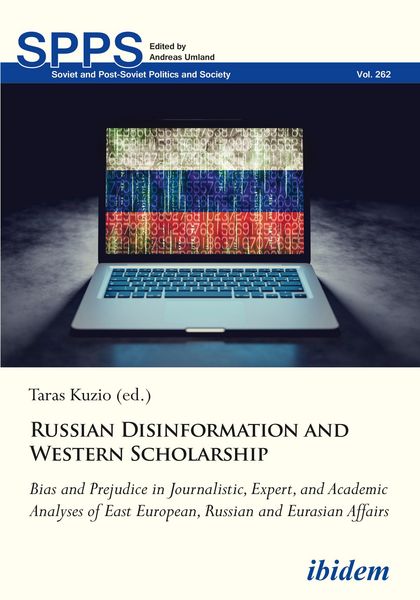
Russian Disinformation and Western Scholarship Bias and Prejudice in Journalistic, Expert, and Academic Analyses of East European, Russian and Eurasian Affairs
Aus der Reihe
Soviet and Post-Soviet Politics and Society
-
- Taschenbuch
- eBook ausgewählt
-
Form:Einzelkauf Download
-
Sprache:Englisch
Fr. 22.00
inkl. gesetzl. MwSt.Beschreibung
Produktdetails
Format
Kopierschutz
Nein
Family Sharing
Ja
Text-to-Speech
Nein
Erscheinungsdatum
18.09.2023
Herausgeber
Taras KuzioVerlag
IbidemSeitenzahl
394 (Printausgabe)
Dateigröße
3914 KB
Sprache
Englisch
EAN
9783838276854
Western academics, experts, and journalists specializing in Eastern Europe, Russia and Eurasia have grappled with two fundamental analytical crises in connection with the 1991 disintegration of the USSR and Russia's 2014 invasion of Ukraine. Both crises were brought about by a similar lack of understanding of Moscow's inability to view its neighbors, in particular Ukraine, as not possessing sovereignty and not treating them as independent states. Typically, they downplayed the historic and current role of Russian imperialism and nationalism.
The book's contributors investigate how the Kremlin's recent turbo-charging of Russia's information warfare, 24-hour TV, and social media activity has expanded on traditional pro-Russian sentiments among Western academics, experts, and journalists. The authors analyze the downplaying of Russian nationalism, misinterpretations of the 2014 crisis, sympathetic portrayals of Crimea's occupation, and the use of the term "civil war" rather than "Russian-Ukrainian war" for the Donbas conflict in academia as well as the think tank world and media in the UK, Germany, Poland, Czech Republic, Japan, USA, and Canada.
The book's contributors investigate how the Kremlin's recent turbo-charging of Russia's information warfare, 24-hour TV, and social media activity has expanded on traditional pro-Russian sentiments among Western academics, experts, and journalists. The authors analyze the downplaying of Russian nationalism, misinterpretations of the 2014 crisis, sympathetic portrayals of Crimea's occupation, and the use of the term "civil war" rather than "Russian-Ukrainian war" for the Donbas conflict in academia as well as the think tank world and media in the UK, Germany, Poland, Czech Republic, Japan, USA, and Canada.
Noch keine Bewertungen vorhanden
Verfassen Sie die erste Bewertung zu diesem Artikel
Helfen Sie anderen Kundinnen und Kunden durch Ihre Meinung.