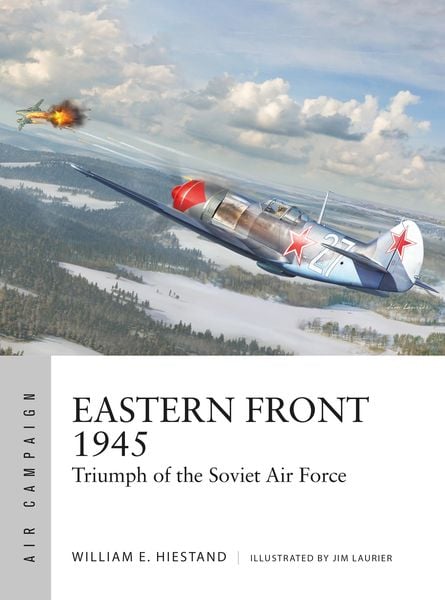
Eastern Front 1945 Triumph of the Soviet Air Force
Aus der Reihe
Air Campaign
-
- Taschenbuch
- eBook ausgewählt
-
Form:Einzelkauf Download
-
Sprache:Englisch
-
eBook Format:ePUB
- PDF Fr. 18.90
- ePUB Fr. 18.90 ausgewählt
Fr. 18.90
inkl. gesetzl. MwSt.Beschreibung
Produktdetails
Format
ePUB
Kopierschutz
Ja
Family Sharing
Nein
Text-to-Speech
Ja
Erscheinungsdatum
18.01.2024
Illustriert von
Jim Laurier
Verlag
Bloomsbury eBooks UKSeitenzahl
96 (Printausgabe)
Auflage
1. Auflage
Sprache
Englisch
EAN
9781472857835
A detailed, illustrated account of the air campaign that accompanied the Red Army's final push towards Berlin, in which massed Soviet air power defeated the Luftwaffe's high-tech Me 262 jets and
Mistel
exploding drones.
The last months of World War II on the Eastern Front saw a ferocious fight between two very different air forces. Soviet Air Force (VVS) Commander-in-Chief Alexander Novikov assembled 7,500 aircraft in three powerful air armies to support the final assault on Berlin. The Luftwaffe employed some of its most advanced weapons including the Me 262 jet and Mistel remotely-guided bomb aircraft.
Using photos, 3D diagrams, maps and battlescene artwork, William E. Hiestand, a military analyst with a longstanding interest in Soviet military history, explains how Germany's use of high-tech weaponry and massed Soviet air assaults was not just the culmination of World War II air combat, but also pointed to how the future rivalry with NATO would play out. The VVS used powerful and flexible air armies to control and employ its huge force of aircraft - organizational and employment concepts that would shape Soviet plans and preparations for combat during the Cold War.
For the first time, this volume explains how air power helped win the war on the Eastern Front, and how victory shaped Soviet air power doctrine for the decades to come.
The last months of World War II on the Eastern Front saw a ferocious fight between two very different air forces. Soviet Air Force (VVS) Commander-in-Chief Alexander Novikov assembled 7,500 aircraft in three powerful air armies to support the final assault on Berlin. The Luftwaffe employed some of its most advanced weapons including the Me 262 jet and Mistel remotely-guided bomb aircraft.
Using photos, 3D diagrams, maps and battlescene artwork, William E. Hiestand, a military analyst with a longstanding interest in Soviet military history, explains how Germany's use of high-tech weaponry and massed Soviet air assaults was not just the culmination of World War II air combat, but also pointed to how the future rivalry with NATO would play out. The VVS used powerful and flexible air armies to control and employ its huge force of aircraft - organizational and employment concepts that would shape Soviet plans and preparations for combat during the Cold War.
For the first time, this volume explains how air power helped win the war on the Eastern Front, and how victory shaped Soviet air power doctrine for the decades to come.
Noch keine Bewertungen vorhanden
Verfassen Sie die erste Bewertung zu diesem Artikel
Helfen Sie anderen Kundinnen und Kunden durch Ihre Meinung.