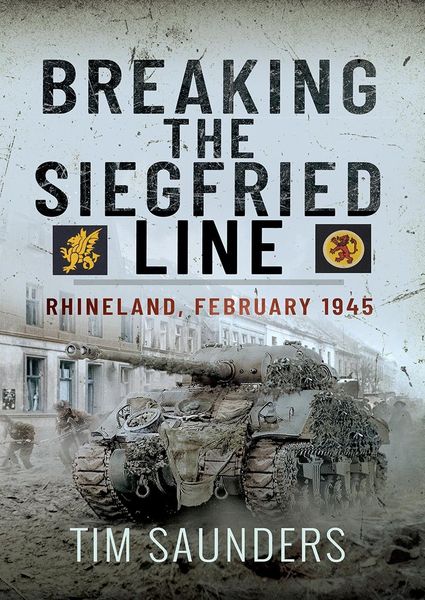
Breaking the Siegfried Line Rhineland, February 1945
-
Form:Einzelkauf Download
-
Sprache:Englisch
-
eBook Format:PDF
- PDF Fr. 13.90 ausgewählt
- ePUB Fr. 13.90
Fr. 13.90
inkl. gesetzl. MwSt.Beschreibung
Produktdetails
Format
Kopierschutz
Ja
Family Sharing
Ja
Text-to-Speech
Nein
Erscheinungsdatum
30.01.2024
Verlag
Pen & SwordSeitenzahl
288 (Printausgabe)
Dateigröße
60363 KB
Sprache
Englisch
EAN
9781399055321
In this second of Tim Saunders' volumes on the opening stage of the 1945 Rhineland Campaign, the focus is to the north of the Reichswald, on the flood plain of the River Rhine and a narrow strip of slightly higher ground.
Amidst the rapidly rising flood waters, 3rd Canadian Division earned the nickname 'The Water Rats' as they fought to clear villages and dykes, while on their right, the 15th Scottish Division fought through the Germans' outer defenses with tanks becoming deeply bogged before facing the Siegfried Line defenses. Even though deceived by a faulty estimate of allied intent, German resistance to the Guards armored Brigade, the specialist assault vehicles of 79th armored Division and the Scottish infantry, was stiff as they broke through the anti-tank ditches and bunkers.
Aiming to maintain momentum, General Horrocks, the commander of XXX Corps, released 43rd Wessex Division and 8 armored Brigade into the narrow corridor between the floods and the Reichswald, which resulted in a terrible traffic jam. Despite this, the West Country soldiers and tanks were soon in the badly bombed ruins of Kleve, the first substantial German city to be taken by the British.
German reaction to the attack on the 'Reichswald plug' was to send their surviving panzer and panzergrenadier formations south into counter attacks to blunt the allied offensive that was poised to spill out into the Rhineland.
Amidst the rapidly rising flood waters, 3rd Canadian Division earned the nickname 'The Water Rats' as they fought to clear villages and dykes, while on their right, the 15th Scottish Division fought through the Germans' outer defenses with tanks becoming deeply bogged before facing the Siegfried Line defenses. Even though deceived by a faulty estimate of allied intent, German resistance to the Guards armored Brigade, the specialist assault vehicles of 79th armored Division and the Scottish infantry, was stiff as they broke through the anti-tank ditches and bunkers.
Aiming to maintain momentum, General Horrocks, the commander of XXX Corps, released 43rd Wessex Division and 8 armored Brigade into the narrow corridor between the floods and the Reichswald, which resulted in a terrible traffic jam. Despite this, the West Country soldiers and tanks were soon in the badly bombed ruins of Kleve, the first substantial German city to be taken by the British.
German reaction to the attack on the 'Reichswald plug' was to send their surviving panzer and panzergrenadier formations south into counter attacks to blunt the allied offensive that was poised to spill out into the Rhineland.
Noch keine Bewertungen vorhanden
Verfassen Sie die erste Bewertung zu diesem Artikel
Helfen Sie anderen Kundinnen und Kunden durch Ihre Meinung.