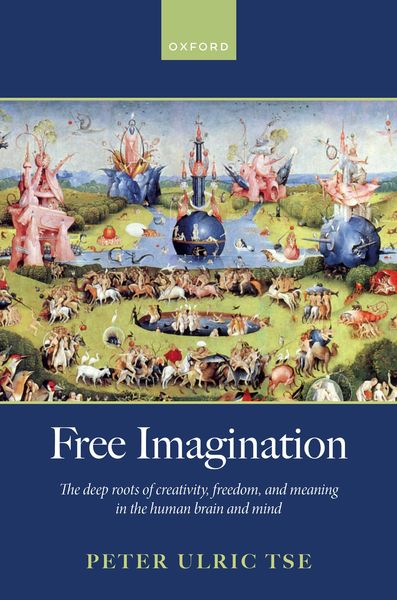
Free Imagination The deep roots of creativity, freedom and meaning in the human brain and mind
-
Form:Einzelkauf Download
-
Sprache:Englisch
-
eBook Format:ePUB
- PDF Fr. 41.90
- ePUB Fr. 41.90 ausgewählt
Fr. 41.90
inkl. gesetzl. MwSt.Beschreibung
Produktdetails
Format
ePUB
Kopierschutz
Ja
Family Sharing
Nein
Text-to-Speech
Ja
Erscheinungsdatum
07.08.2024
Verlag
OUP eBookSeitenzahl
240 (Printausgabe)
Dateigröße
18046 KB
Sprache
Englisch
EAN
9780198901204
Free Imagination argues that the brain's capacity to imagine is the fundamental basis of human Free Will. Laws of physics need not apply in our internal simulations, so virtually anything is possible there. And since some of our actions can follow from that which we imagine, especially from processes of deliberation that involve imagining possible scenarios and outcomes, our actions inherit the freedom of our imaginings. The creative power of the human imagination may have evolved as a consequence of the demodularization of neural circuitry associated with volitional attentional operations over operands downloadable into a mental workspace where, virtually, anything could be combined with anything else. This new cognitive architecture gave rise to the danger of psychosis. Our schizotypal form of imagination, arising from the promiscuous, generative and iterative combination of disencapsulated operators and operands in a mental workspace, may have evolved only in humans by exapting from existing motoric and other operations involved in volitional hand dexterity to a domain of premotoric simulation. What we imagine into existence can be used for good or evil. Imagination is therefore our greatest tool and weapon. When applied to ourselves, it allows us the possibility of reimagining and then transforming ourselves in light of second-order desires. This gives us the ability to choose to become a new kind of chooser in the future. Other animals lack this second-order Free Will; although they can do otherwise, they cannot want to become otherwise than they are, making them amoral. This book explores the idea that because humans, in contrast, have second-order Free Will, they can be moral or immoral.
Noch keine Bewertungen vorhanden
Verfassen Sie die erste Bewertung zu diesem Artikel
Helfen Sie anderen Kundinnen und Kunden durch Ihre Meinung.