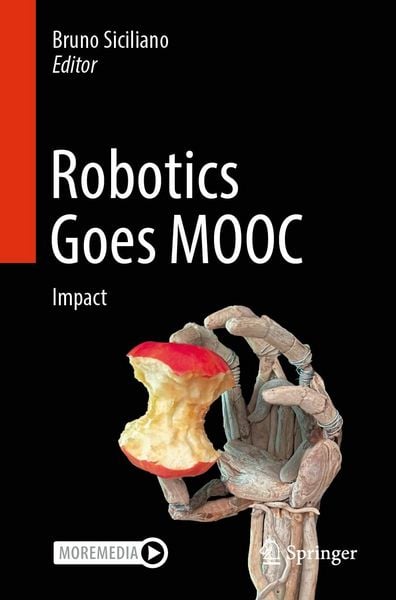
Robotics Goes MOOC Impact
-
- Taschenbuch
- eBook ausgewählt
-
Form:Einzelkauf Download
-
Sprache:Englisch
Fr. 69.90
inkl. gesetzl. MwSt.Beschreibung
Produktdetails
Format
Kopierschutz
Nein
Family Sharing
Nein
Text-to-Speech
Nein
Erscheinungsdatum
07.05.2025
Herausgeber
Bruno SicilianoVerlag
SpringerSeitenzahl
479 (Printausgabe)
Dateigröße
28429 KB
Sprache
Englisch
EAN
9783319772677
It is often read in the media that AI and Robotics are the primary cause of technology unemployment. AI and machine learning techniques are expected to take over lower-level tasks, while humans can spend more time with higher-level tasks. In perspective, it can be said that jobs requiring boring cognitive tasks or repeatable and dangerous physical tasks will be considerably shredded by automation thanks to the wide adoption of AI & Robotics technology to replace humans, while jobs requiring challenging cognitive tasks or unstructured physical tasks will be suitably re-engineered with the progressive introduction of AI & Robotics technology to assist humans.
From the discussion above, it should be clear that in a world populated by humans and robots, issues arise that go beyond engineering and technology due to the impact resulting from the use of robots in various application scenarios. The anthropization of robots cannot ignore the resolution of those ethical, legal, sociological, economic (ELSE) problems that have so far slowed their spread in our society.
The final book of the Robotics Goes MOOC project enlightens the impact of using robotic technology in the main fields of application, namely, industrial robots as in Chapter 1 by Bischoff et al, medical robotics as in Chapter 2 by Dario et al, aerial robots as in Chapter 3 by Ollero et al, orbital robotics as in Chapter 4 by Lampariello, underwater robots in Chapter 5 by Antonelli, and rescue robots as in Chapter 6 by Murphy. The last part is devoted to the open dilemma of using and accepting robots in human co-habited environments which is addressed in Chapter 7 on social robotics by Pandey and the very final chapter by Tamburrini on the important issues raised with roboethics.
Noch keine Bewertungen vorhanden
Verfassen Sie die erste Bewertung zu diesem Artikel
Helfen Sie anderen Kundinnen und Kunden durch Ihre Meinung.